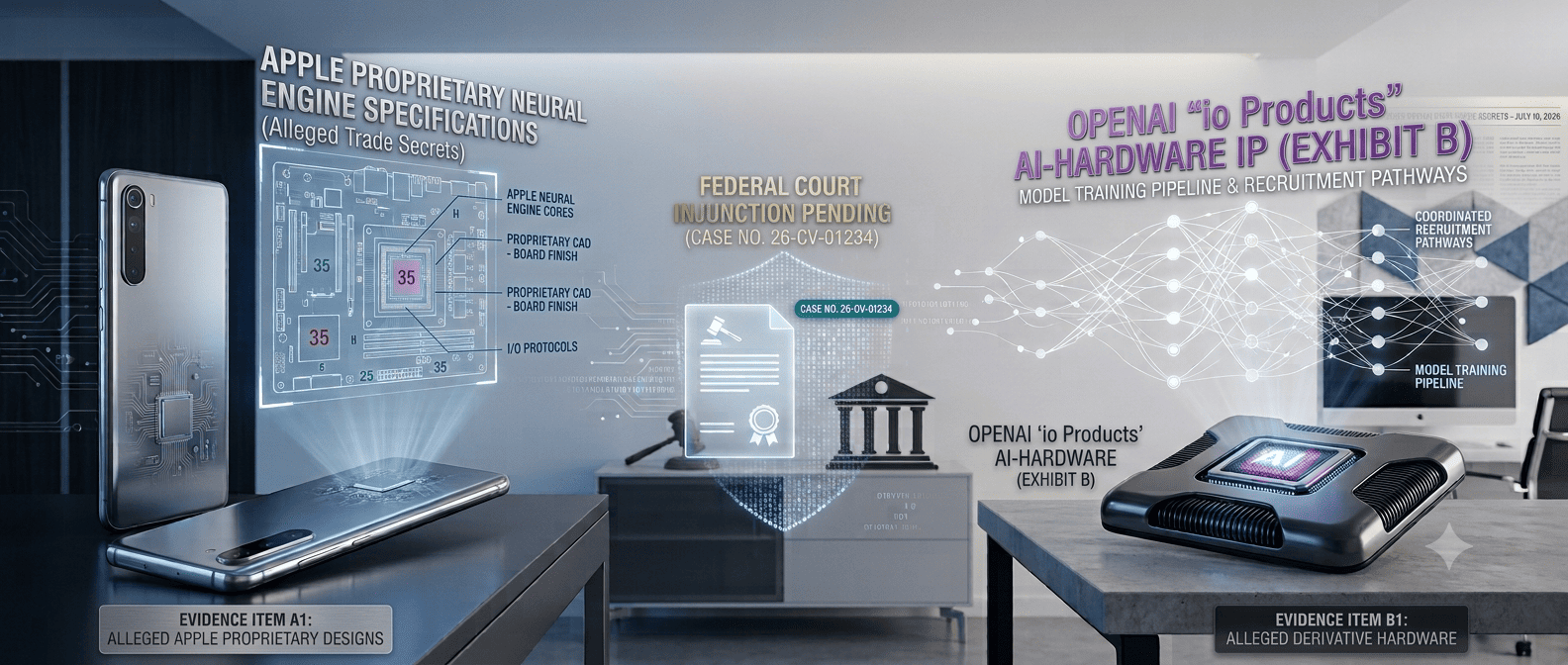
Apple and OpenAI started 2026 as partners. They ended it in court. In July 2026, Apple sues OpenAI in a federal lawsuit filed in a US district court in San Jose, accusing the AI company of stealing its trade secrets to build a competing hardware business. The complaint names OpenAI's chief hardware officer Tang Tan, electrical engineer Chang Liu, and the startup io Products, which OpenAI acquired for $6.5 billion in 2025.
This is more than a legal dispute between two tech giants. It is a window into how fiercely companies will fight to protect their innovations as the AI hardware race heats up.
Apple Sues OpenAI: What Is Actually Happening?
According to Apple's lawsuit, OpenAI encouraged employees leaving Apple to bring confidential materials with them, including unreleased parts, manufacturing documents, and internal presentations. Tang Tan, who spent 24 years at Apple overseeing iPhone product design, allegedly coached recruits on how to avoid Apple's security protocols and asked candidates to bring physical Apple components, such as batteries, logic boards, and shields, to job interviews at OpenAI.
Chang Liu, who left Apple in January 2026, reportedly downloaded dozens of confidential hardware files before his departure. Apple discovered the alleged theft when Liu never returned his company laptop and was found to still have access to Apple's internal file-sharing system.
Apple wrote to OpenAI in February raising concerns but received no response, which led to the lawsuit being filed. Apple is seeking an injunction, monetary damages, and the return of any stolen property. OpenAI denies the allegations, with spokesperson Drew Pusateri stating, "We have no interest in other companies' trade secrets."
Why the Concept of Trade Secrets Matters Here
Before diving into the analysis, it helps to understand what trade secrets actually are. A trade secret is any confidential business information that gives a company a competitive edge. This can be a recipe, a manufacturing process, a design, or a technical specification. What makes it a trade secret is that it is kept private and the company takes steps to protect it.
Apple's lawsuit claims that OpenAI did not just recruit talented people. It allegedly recruited those people's knowledge, files, and access to Apple's most sensitive hardware information. That is the heart of the legal argument.
Why Is This Happening? The Business Analysis
The key driver here is competition. Apple and OpenAI are no longer just partners. They are rivals.
The two companies announced a landmark partnership in 2024, integrating ChatGPT into iPhones, MacBooks, and iPads. But that relationship has frayed significantly. According to reporting by Bloomberg, Apple has shifted toward using Google's Gemini AI as the foundation for its in-house AI models. OpenAI, meanwhile, is building a range of AI-powered consumer hardware devices, expected to launch no earlier than April 2027. The two companies are now heading toward a direct collision in the same market.
OpenAI has hired more than 400 former Apple employees, according to the lawsuit. That number alone tells a story. When a competitor aggressively recruits from your workforce, the risk of confidential information walking out the door rises considerably. Apple's lawsuit suggests that risk became a reality.
For OpenAI, the pressure to ship a physical product is real. Apple describes OpenAI as resorting to "unlawful shortcuts" due to "mounting pressure to deliver its first commercial hardware product." Whether or not that characterization holds up in court, it reflects a genuine dynamic: hardware is hard, expensive, and time-consuming to build from scratch.
Impact of the Lawsuit
On Consumers
For now, the average consumer will not feel much. OpenAI's hardware devices have not launched yet, and Apple's existing products are unaffected. However, if the lawsuit results in delays to OpenAI's hardware rollout, consumers waiting for AI-powered devices from OpenAI will have to wait even longer.
On the Companies
For Apple, this lawsuit is a statement. It signals that the company is watching its talent pipeline closely and will take legal action when it believes confidential information has been misused. It also reveals that Apple's partnership with OpenAI has broken down to the point where the two companies are willing to face each other in federal court.
For OpenAI, the reputational damage could be significant. Trust is essential when signing partnerships and attracting investors. Being publicly accused of building a hardware business on stolen information is not a good look, especially when the company is still working to establish its hardware credentials.
On the Industry
This case is being compared to the 2017 Waymo v. Uber lawsuit, where Waymo accused Uber of stealing hardware designs after a former engineer departed with thousands of confidential files. That case settled for $245 million. The Apple versus OpenAI case could set a similarly important precedent for how Silicon Valley handles talent movement and confidential information in the AI era.
Going forward, expect companies across the tech sector to tighten their offboarding processes, reinforce non-disclosure agreements, and monitor data access more closely when employees leave for competitors.
Strategic Response: What Should Companies Do?
This lawsuit is a reminder that intellectual property protection is a business strategy, not just a legal formality. Companies building proprietary technology need to:
Strengthen exit protocols: Ensure departing employees return all equipment and lose system access immediately.
Audit data access regularly: Know who has access to sensitive files and revoke permissions when roles change.
Segment confidential information: Limit access to trade secrets on a need-to-know basis so fewer people can walk out with critical data.
Act quickly when concerns arise: Apple wrote to OpenAI in February and, having received no response, filed a lawsuit by July. Inaction after raising concerns creates legal vulnerability.
Future Outlook
Base Case
The case settles out of court within 18 to 24 months, similar to the Waymo v. Uber case. OpenAI pays a financial settlement, returns or destroys the disputed materials, and agrees to certain hiring restrictions. Both companies move on, though the partnership between them remains dead.
Upside Case for Apple
A court ruling in Apple's favor would strengthen IP protections across the tech industry and send a clear warning to companies that recruit talent from competitors. It could also delay OpenAI's hardware ambitions significantly and slow down a rival before it launches.
Downside Case for Apple
If OpenAI successfully argues that the information was not used or that its employees acted independently, Apple could walk away with minimal damages and a prolonged legal battle that distracts from its own product roadmap.
Key Insights
The Apple versus OpenAI lawsuit is fundamentally a story about the AI hardware race and the lengths companies will go to win it.
Protecting talent and knowledge has become just as important as protecting patents.
Former employees are now a liability risk as well as an asset for any company operating in a high-competition space.
Partnership agreements in the AI industry are increasingly fragile. Today's collaborator can become tomorrow's competitor.
Business Terms You Can Learn From This Case
Trade Secret: Confidential business information that provides a competitive advantage. Examples include manufacturing processes, product designs, and supplier relationships. Companies must actively protect this information to maintain legal rights over it.
Intellectual Property (IP): A broad term for creations of the mind that can be legally owned, including inventions, designs, and brand names. Patents, trademarks, and copyrights are all forms of IP protection.
Proprietary Information: Information owned by a company that is not publicly available. This overlaps with trade secrets but can also include business strategies, financial data, and customer lists.
Corporate Governance: The rules, practices, and processes by which a company is directed and controlled. Good governance includes clear policies on data access, employee conduct, and handling of sensitive information.
Competitive Advantage: The unique edge a company has over its rivals. This can come from technology, talent, brand recognition, or cost structure. Trade secrets are often the foundation of a company's competitive advantage.
What Comes Next
The Apple versus OpenAI case is one of the most significant IP disputes in Silicon Valley since the Waymo versus Uber battle. The outcome will shape how tech companies manage employee transitions, protect their hardware knowledge, and structure partnerships with potential rivals.
For students and professionals watching this unfold, the lesson is straightforward: innovation is valuable, and the people who carry that knowledge are both an asset and a risk. The companies that manage this tension well will have a meaningful edge in the years ahead.