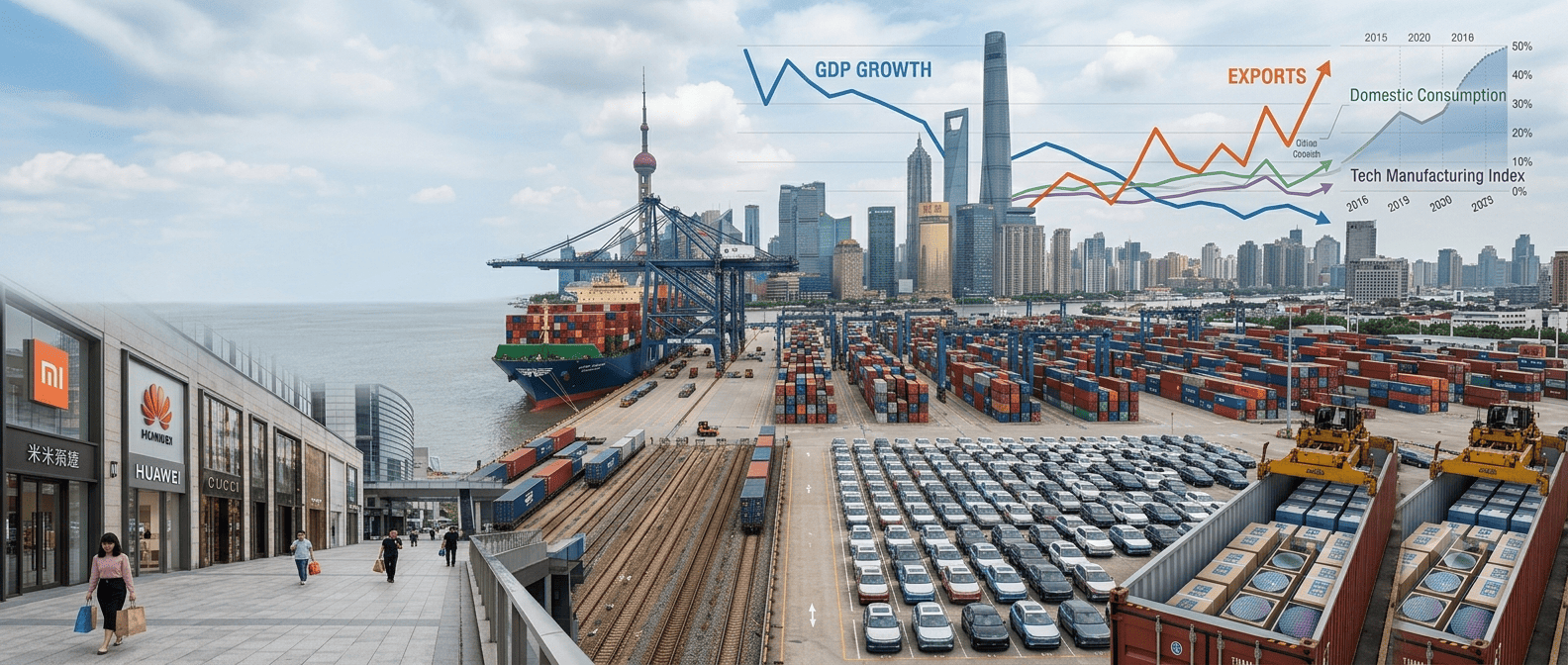
China economic growth is one of the most closely watched indicators in global business. When an economy grows, companies expand, jobs are created, consumer spending rises, and investors gain confidence. When growth slows, the opposite tends to happen. Businesses become cautious, hiring slows, and spending pulls back. That is why when the world's second largest economy reports weaker-than-expected growth, the effects are felt far beyond its borders, across supply chains, financial markets, and business strategies worldwide.
That is exactly what happened in the second quarter of 2026. China's economy grew by just 4.3%, below the government's own target and the slowest pace in over three years. Exports are breaking records. Factories are running. Semiconductors are flying off the shelves. Yet domestic demand tells a very different story. So what is really going on, and what can businesses learn from it?
This post breaks down what happened, what it signals, and how businesses around the world are responding. Along the way, we will explain the key business and economic terms so you can follow along, no economics degree required.
What the Latest China Economic Growth Data Shows
Indicator | Latest |
GDP Growth | 4.3% |
Previous Quarter | 5.0% |
Exports | +27% |
Retail Sales | +1% |
New Home Prices | -0.1% |
China's National Bureau of Statistics reported that GDP (gross domestic product, which is the total value of all goods and services a country produces) grew by 4.3% in the April to June 2026 quarter, down from 5% in Q1. That figure missed the government's annual target range of 4.5% to 5%, which is itself the lowest growth target China has set since 1991.
On the surface, several numbers look impressive. Exports surged 27% year-on-year in June, hitting a record $412.39 billion, according to Trading Economics. Semiconductor exports alone jumped 122%, the fastest pace in 13 years. Electric vehicle exports exceeded one million units in a single month for the first time ever, with Chinese EV makers now holding a 15% market share in Europe.
But underneath those headline figures, the domestic picture is far more fragile. Retail sales, which measure how much consumers are spending in shops and online, rose just 1% in June after falling the month before. Fixed-asset investment (money spent on building factories, infrastructure, and equipment) shrank 5.7% in the first half of the year. Property investment contracted 18% year-on-year. New home prices fell 0.1% in June and are down 3.3% compared to a year ago.
The gap between China's export strength and domestic weakness is the central story here.
Why Is China Economic Growth Slowing?
Weak Consumer Demand
Consumer confidence refers to how optimistic people feel about their financial situation and the broader economy. Right now, Chinese consumers are not feeling great. Wages have stagnated or declined in several sectors. Tens of millions of workers have shifted from stable jobs into the gig economy, taking on delivery and ride-hailing work with lower pay and fewer benefits. As one importer interviewed by Reuters put it, "Apart from necessary spending on food, I save on anything I can. I haven't bought a single piece of clothing in six months."
When people feel financially uncertain, they cut back on discretionary purchases. That is a term for non-essential spending, things like new phones, gym memberships, restaurant meals, or holidays. When discretionary spending drops across an entire country, it drags on GDP growth significantly.
Property Market Weakness
China's property sector has been in decline since 2021. The housing market matters enormously to Chinese households because most family wealth is tied up in property. When home values fall, people feel poorer, even if they have not actually sold their homes. This psychological effect reduces their willingness to spend. Property investment has now been contracting for years, and the effects on construction employment, consumer confidence, and local government finances have compounded over time.
Rising Energy and Input Costs
The ongoing conflict involving Iran has pushed up global energy prices and created uncertainty in commodity markets. Input costs refer to the prices businesses pay for the raw materials and energy needed to produce goods. When these rise, profit margins, the difference between what a product costs to make and what it sells for, get squeezed. Some manufacturers have responded by cutting staff, which further depresses consumer spending.
Economic Rebalancing
As Andy Ji, an analyst at ITC Markets, described it to Reuters: "A high-tech-driven industrial engine running alongside cratering domestic consumption and investment firmly highlights the economy's deeply uneven growth momentum." In short, China is producing and exporting more than ever, but its own people are not the ones buying it.
Impact of the Slowdown
Impact on Consumers
For ordinary Chinese households, the slowdown translates into a cycle that is difficult to break. Lower wages lead to less spending. Less spending reduces business revenues. Lower revenues lead to cost-cutting and job losses. More job insecurity leads to even less spending. Chinese policymakers have introduced trade-in subsidies for appliances and vehicles to stimulate purchases, but so far the effect has been modest.
Impact on Companies
Businesses operating in China face a tough environment. Domestic-facing companies, particularly in retail, real estate services, and hospitality, are seeing revenues decline. Firms that rely on Chinese consumer spending are adjusting their expectations downward. Morgan Stanley cut its full-year China growth forecast to 4.6% from 4.8%, and the IMF, while raising its 2026 estimate to 4.6%, expects growth to slow further to 4.1% in 2027.
To understand the real-world stakes, consider companies like Apple, Tesla, Volkswagen, and major luxury brands. China is one of their largest and most important markets. Apple generates a significant share of its global revenue from Chinese consumers. Tesla has invested heavily in its Shanghai Gigafactory. Volkswagen sells more cars in China than anywhere else in the world. When Chinese household spending slows, these companies feel it directly in their sales figures. It also shapes their decisions about where to build new factories, how much to invest in local operations, and whether to expand or pull back. A weaker Chinese consumer is not just a local problem. It is a strategic concern for some of the world's biggest businesses.
For exporters, the picture is more positive, but risks are building. U.S. tariffs are expected to rise when the current 10% universal rate expires on July 24, 2026. The U.S. Trade Representative has proposed a 12.5% tariff on Chinese imports. The EU, which recorded a trade deficit with China averaging $1 billion a day last year, is also tightening protections. A significant portion of the June export surge also reflected frontloading, where U.S. retailers rushed to build up inventory before expected tariff increases, meaning some of that demand has already been pulled forward.
Impact on Global Industries
The global AI boom has created a massive appetite for semiconductors, and China has captured a huge share of that demand. But this dependency cuts both ways. If AI investment slows or if regulators restrict chip exports, the export engine could stall quickly. For industries beyond tech, including commodities, raw materials, and agricultural exports that sell into China, weaker Chinese domestic demand is already translating into softer prices and reduced volumes.
Strategic Response
Expanding Export Markets
Chinese businesses are actively diversifying their trade relationships. Exports to ASEAN grew 34.6% in June, while shipments to Latin America rose 28%. Some companies are setting up manufacturing facilities in Europe and Southeast Asia to get around tariffs. This reduces supply chain risk and helps maintain access to key markets.
Investing in High Growth Industries
The strong performance of semiconductors, EVs, and AI-related hardware signals where China's competitive advantage is strengthening. Companies that supply components or services to these sectors stand to benefit from continued demand, at least in the near term.
Improving Operational Efficiency
When profit margins are under pressure, businesses look inward. That means reducing waste, automating where possible, renegotiating supplier contracts, and focusing investment on the highest-returning activities. For companies operating in China, now is a time to scrutinize costs carefully.
Supporting Consumer Spending
Zhiwei Zhang, chief economist at Pinpoint Asset Management, noted that "there is a general consensus among policymakers and researchers that China needs to boost domestic demand. But there is no consensus how to do it." The government has signaled some monetary easing but appears reluctant to take on more debt through large-scale fiscal stimulus. Watching what Beijing announces at its end-of-July Politburo meeting will be important for understanding the policy direction ahead.
Future Outlook
Base Case
China achieves growth somewhere in the 4.5% to 4.7% range for 2026. Exports remain strong through Q3, supported by global AI demand and pre-tariff inventory building. Domestic consumption recovers slowly as trade-in subsidies and modest policy support take effect. The property market stabilizes without a sharp recovery.
Upside Case
A significant policy shift, whether through expanded fiscal spending, household income support, or accelerated property sector reform, triggers a stronger consumer rebound. Export demand holds even as tariffs rise, supported by continued AI infrastructure investment globally. Growth exceeds 5% for the full year.
Downside Case
Tariffs increase sharply across multiple markets simultaneously, cutting into China's export momentum. Consumer confidence deteriorates further as job losses mount and home prices continue to fall. Growth falls below 4.5%, putting the government's revised target out of reach and forcing larger stimulus measures that add to an already stretched debt burden.
Key Takeaways
GDP growth slowing does not always mean crisis. At 4.3%, China is still growing faster than most major economies. The concern is the composition of that growth, not just the headline number.
Export-led growth has limits. When trading partners impose tariffs or slow their own economies, reliance on exports becomes a vulnerability.
Consumer demand is the missing ingredient. Until wages rise, the property market stabilizes, and confidence returns, domestic spending is unlikely to pick up meaningfully.
The AI boom is creating real winners. Semiconductor and tech hardware exporters are experiencing genuine structural demand, not just a short-term spike.
Policy decisions over the coming months will be critical. Watch for signals from the Chinese government on fiscal spending, debt tolerance, and property sector interventions.
Business Terms You Learned
GDP (Gross Domestic Product): The total value of all goods and services a country produces in a given period. It is the most common measure of economic size and growth.
Consumer Confidence: How optimistic people feel about their financial situation and the economy. High confidence leads to more spending; low confidence causes people to save more and spend less.
Discretionary Spending: Money spent on non-essential items such as dining out, travel, clothing, and entertainment. This type of spending is the first to fall when consumers feel uncertain.
Property Investment: Money put into buying, building, or developing real estate. In China, this has historically been a major driver of economic activity and household wealth.
Input Costs: The costs a business pays for raw materials, energy, and other resources needed to produce goods or services. Rising input costs can squeeze profitability.
Profit Margin: The difference between what it costs to produce something and what it sells for. A higher margin means more profit; a lower margin means less room for error.
Fiscal Stimulus: When a government increases spending or cuts taxes to boost economic activity. It is often used during slowdowns to encourage growth.
Trade Diversification: The strategy of selling to or buying from a wider range of countries, reducing dependence on any single market or trading partner.
What This Means for You
China's economic situation is a real-world case study in the tension between short-term growth and long-term structural health. For students of business and economics, it illustrates how an economy can look strong on some measures while facing serious underlying challenges on others. For anyone working in trade, finance, or global supply chains, understanding these dynamics is not optional knowledge.
As Larry Hu of Macquarie Group put it: "What will cause the current situation to change is when exports fail. When exports slow down, the government will do more on domestic demand." The question is whether that shift happens by design or by necessity.