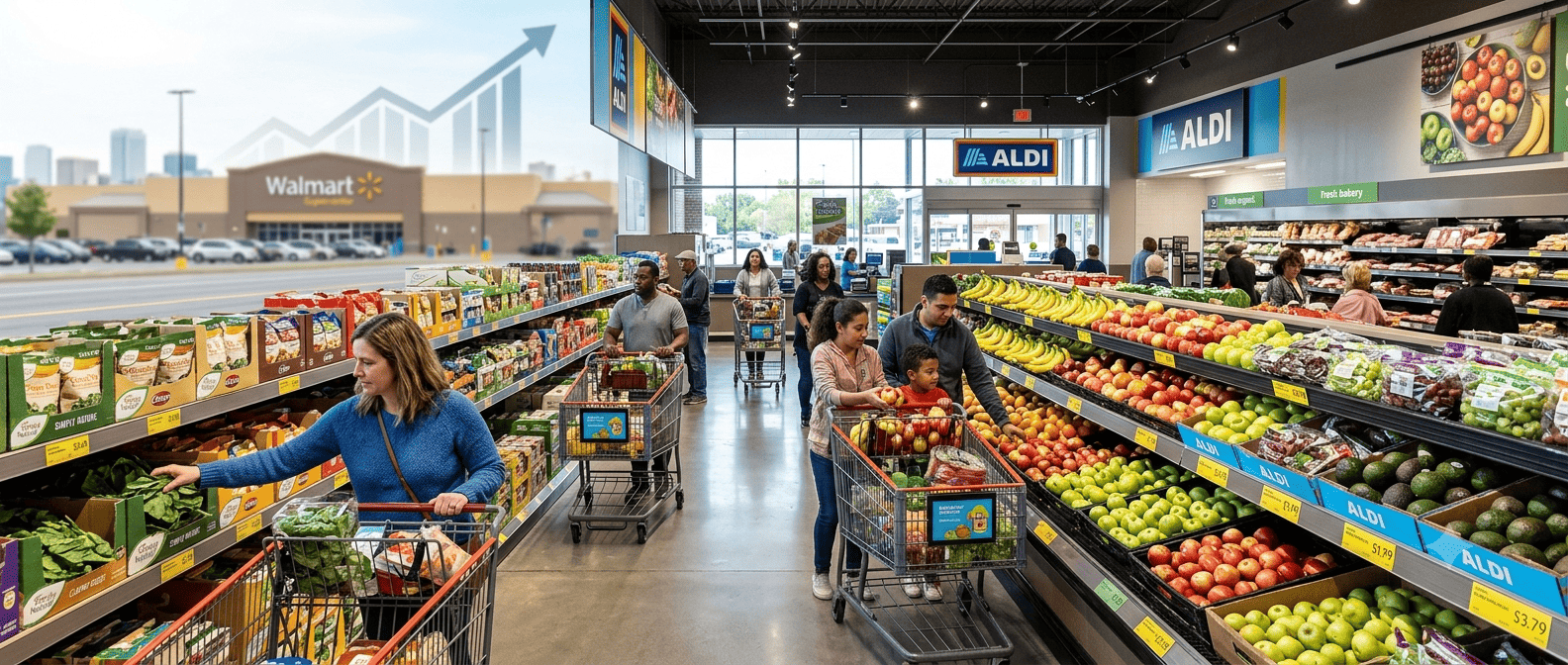
German discount grocer Aldi has been quietly building one of the most aggressive retail growth stories in recent American history. The Aldi US expansion plan, announced in March 2024, commits more than $9 billion to adding 800 new stores across the country by the end of 2028. That would bring Aldi's total footprint to roughly 3,200 locations nationwide, up from nearly 2,800 by the close of 2026.
The numbers are big. But the business story behind them is even more interesting. This post breaks down what is happening, why it is happening, and what it means for consumers, competitors, and the broader grocery industry.
What Is Happening: The Aldi US Expansion at a Glance
Aldi's $9 billion investment covers a mix of new store builds and conversions of acquired locations. When Aldi completed its acquisition of Southeastern Grocers, including the Winn-Dixie and Harveys Supermarket chains, it gained access to approximately 400 stores across Alabama, Florida, Georgia, Louisiana, and Mississippi. Around 200 of those are set to convert to the Aldi format by the end of 2027, with nearly 90 already converted or open as of early 2026.
New markets are also entering the picture. In 2026 alone, Aldi is moving into Maine (Portland), Colorado (Denver and Colorado Springs, with 50+ stores planned), and expanding further across Arizona and Las Vegas. Three new distribution centers are being built in Florida, Colorado, and Arizona to support the growth.
With roughly 3% market share in 2025 (according to International Supermarket News estimates), Aldi trails well behind Walmart's 21.2%, Kroger's 8.8%, and Costco's 8.5%. But the rate of growth is what competitors are watching closely.
Why Aldi US Expansion Is Happening
Inflation Has Changed How Americans Shop
Persistent inflation pushed millions of American consumers to rethink where and how they buy groceries. When everyday expenses rise, shoppers become less loyal to brands and more loyal to prices. Aldi's low-cost model became highly attractive in this environment. The company reported 17 million new customers visiting its stores in 2025 alone, a figure that signals a genuine shift in consumer behavior rather than a temporary spike.
This matters from a business strategy perspective because consumer behavior shifts during economic pressure tend to be sticky. Once shoppers discover they can get quality groceries at a lower price, many do not return to their old habits even when financial pressure eases.
Aldi Uses a Cost Leadership Strategy
Aldi's entire business model is built on cost leadership, the strategy of becoming the lowest-cost producer or seller in a market. Every operational decision Aldi makes traces back to this goal.
The stores are small, averaging around 22,000 square feet compared to Winn-Dixie's average of 48,000 square feet. A smaller footprint means lower rent, lower energy costs, and less staff required. The product range is deliberately limited. Where a traditional supermarket might stock thousands of different items, Aldi keeps its selection lean, which simplifies purchasing, logistics, and shelf management.
Approximately 90% of products sold in Aldi stores are private-label brands, meaning products made and sold under Aldi's own name rather than a national brand. This eliminates the markup that comes with brand licensing and advertising costs built into name-brand products.
Even small operational details reflect this strategy. The refundable quarter deposit required to use a shopping cart removes the need for staff to collect carts from the parking lot. These micro-efficiencies add up at scale.
Operational Efficiency Lowers Costs Across the Entire Chain
Aldi's operational efficiency extends beyond the store floor. A tightly controlled supply chain, limited SKU count (the number of individual product types carried), and standardized store layouts reduce complexity at every level of the business. Fewer products mean fewer supplier relationships, less warehouse variety, and faster restocking.
The company has also been investing in technology. Aldi has installed self-checkout kiosks across stores and piloted a fully automated checkout system at a location near its Illinois headquarters. These investments reduce long-term labor costs and improve the speed of the shopping experience.
Urban and Underserved Markets Offer Long-Term Growth
Traditional Aldi locations have often been in suburban or semi-rural areas where retail space is cheaper. The current expansion deliberately targets urban markets and cities where Aldi has little or no presence. Las Vegas, Portland, Denver, and Phoenix represent populations with high foot traffic and, in many cases, a shortage of affordable grocery options. Entering these markets now gives Aldi the opportunity to establish brand loyalty before larger competitors can respond effectively.
Impact: Who Feels the Change?
On Consumers
The most direct impact of Aldi's expansion is more choice and lower prices. When a discount grocer enters a new market, it creates competitive pressure that often forces other retailers to adjust their pricing. Consumers in cities like Denver and Portland who previously had limited access to low-cost grocery options will benefit from Aldi's arrival.
There is also a quality signal worth noting. Aldi's private-label products have improved significantly over the past decade, and the brand now attracts shoppers across income levels, not just budget-conscious ones.
On Companies
For traditional grocery chains, Aldi's growth is a direct threat. GlobalData Managing Director Neil Saunders described the 800-store announcement as "Aldi throwing down the gauntlet to traditional grocery players," calling it "a major challenge to the market which could cause significant disruption and pain for other retailers" (Grocery Dive, 2024).
Mid-sized regional grocers are particularly vulnerable. They lack the scale to match Aldi on price and the digital infrastructure to compete on convenience. For them, the Aldi US expansion is not background noise; it is an existential pressure.
On the Grocery Industry
The broader industry is now in a period of strategic reflection. The FTC's decision to block the proposed Kroger-Albertsons merger has left the top-tier players unable to consolidate through large acquisitions. That means competing through pricing, private-label development, and technology investment is now the primary path forward.
Aldi's expansion is accelerating these conversations. Retailers that have neglected their economy private-label tiers are now under real pressure to develop them. As retail analyst Jon Hauptman noted, having a "robust assortment of economy private label" is increasingly critical for traditional supermarkets to protect their price image without slashing prices across the board (Supermarket News).
Strategic Response: Aldi and Its Competitors
Aldi's strategy is clear: grow the store count, keep prices low, and win on convenience. Its CEO Atty McGrath stated in early 2026 that the focus is on "making it even easier for customers to shop our aisles first," which includes upgrading the website and adding distribution centers to ensure shelves stay stocked.
Walmart, for its part, holds a 21.2% market share and is not standing still. The retailer has been investing heavily in retail media, delivery logistics, and data-driven personalization. It is also expanding its own private-label offerings under the Great Value brand. Walmart's technology investments are designed to make the shopping experience faster and more personalized, areas where Aldi's no-frills model currently does not compete.
The key tension here is a classic business strategic trade-off. Aldi wins on price and simplicity. Walmart wins on range, digital integration, and convenience. Each is doubling down on what it does best, which makes direct head-to-head competition less likely than a division of the market along value lines.
Future Outlook
Base case: Aldi reaches its target of approximately 3,200 stores by the end of 2028, grows its market share from around 3% toward 4-5%, and solidifies its position as the go-to discount grocer for price-sensitive American households. Winn-Dixie conversions proceed as planned, adding a strong presence in the Southeast.
Upside case: Inflation persists or consumer preferences permanently shift toward value shopping. New market entries outperform expectations, and Aldi accelerates conversions. Market share climbs faster than projected, and traditional mid-tier grocers are forced into defensive mergers or market exits.
Downside case: Economic recovery reduces urgency around value shopping. The size mismatch between converted Winn-Dixie stores (averaging 48,000 square feet) and the standard Aldi format (22,000 square feet) creates operational challenges. Execution delays slow the conversion timeline, and some urban markets prove harder to penetrate than expected.
Key Insights for Business Students
Timing a growth move matters. Aldi is not just expanding; it is expanding during a period of maximum consumer openness to switching. That timing is strategic, not accidental.
Acquisitions can serve multiple goals. The Southeastern Grocers acquisition gave Aldi real estate, geographic reach, and established customer relationships simultaneously.
Cost leadership requires discipline at every level. From store size to cart deposits, every part of Aldi's model reinforces the same goal.
Market share does not tell the full story. At 3%, Aldi appears small. But its growth rate and strategic positioning mean it punches well above that number in terms of competitive influence.
Aldi's Expansion Is a Business Case Worth Watching
The Aldi US expansion is not simply a retail story. It is a live case study in cost leadership, market timing, acquisition strategy, and competitive dynamics. Students learning about business strategy will find real-world examples of almost every major concept here: private-label development, operational efficiency, supply chain management, and competitive response.
The grocery market is moving fast. Aldi's $9 billion bet is that Americans are ready for a different kind of supermarket experience. Based on 17 million new shoppers in a single year, it appears many already agree.
Business Terms You Can Learn
Term | Definition |
Cost Leadership | A strategy where a company aims to become the lowest-cost producer in its industry, allowing it to offer lower prices than competitors while still making a profit |
Private Label | Products manufactured by one company but sold under a retailer's own brand name, cutting out the costs associated with national brand licensing and marketing |
Market Share | The percentage of total industry sales held by one company, used to measure how dominant a business is within its market |
Operational Efficiency | The ability to deliver products or services in the most cost-effective way possible without sacrificing quality, often achieved through process improvements and technology |
Economies of Scale | The cost advantages a business gains as it grows larger, because fixed costs are spread across more units, making each unit cheaper to produce or distribute |
Supply Chain | The entire network of suppliers, manufacturers, warehouses, and delivery systems involved in getting a product from its source to the customer |
Consumer Behavior | The study of how individuals make decisions about what to buy, when, and why, influenced by factors like price, habit, culture, and economic conditions |