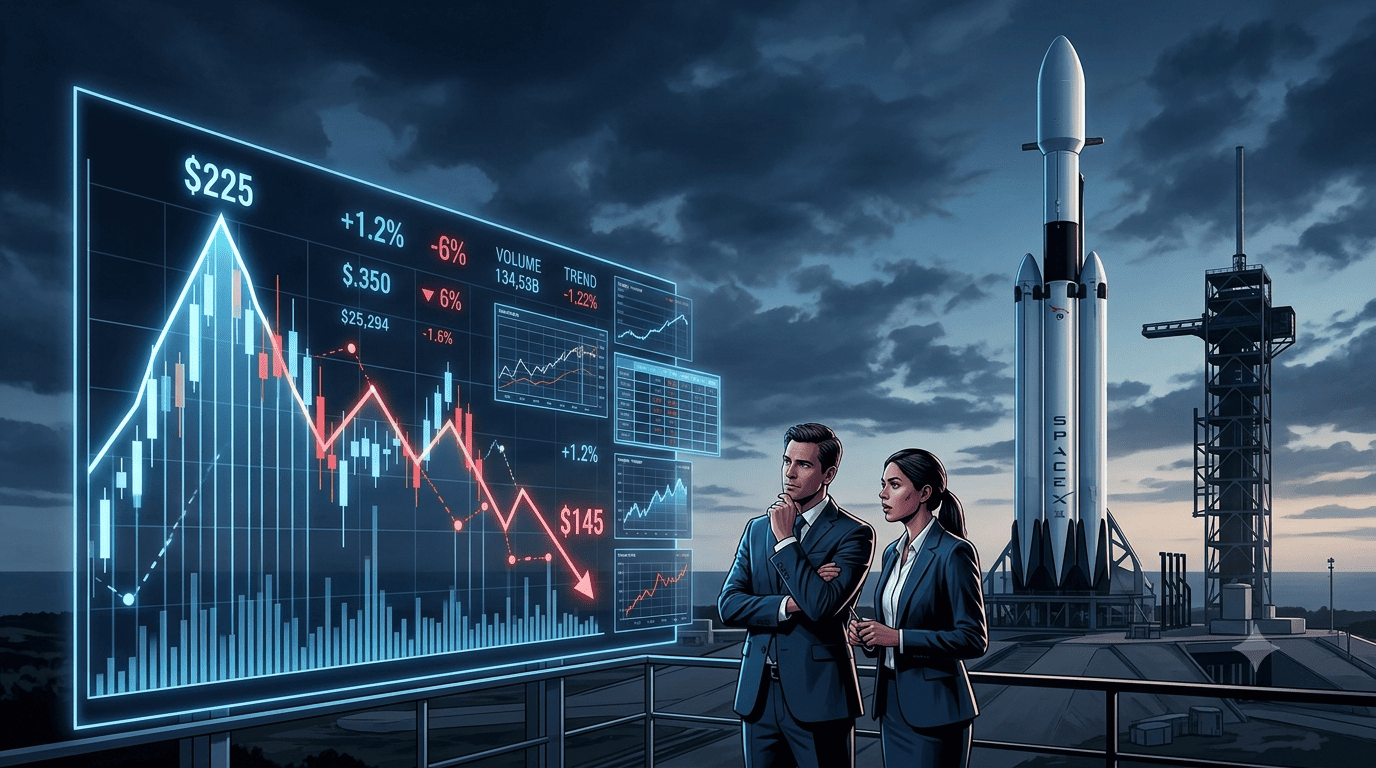
The most anticipated stock market debut in history lasted about a week before reality set in. When SpaceX went public on June 12, 2026, it raised $75 billion in the largest SpaceX IPO ever recorded, pricing shares at $135 and opening at $150. By June 16, the stock had surged to an all-time high of $225.64. Less than four weeks later, it was trading below $150. This post breaks down exactly what happened, what it reveals about how markets price AI-driven companies, and what business students and investors can learn from the fastest post-IPO boom-and-bust of the decade.
What Happened: From Record Debut to $1 Trillion Erased
The first three days of trading were euphoric. On its first full day of trading (June 15), SpaceX stock closed at $192.50, a 20% single-day gain. Trading volume rivaled Facebook's 2012 debut, with over 500 million shares changing hands on day one alone.
Then came June 16. SpaceX announced it would acquire Cursor, an AI coding startup, for $60 billion in an all-stock transaction. That deal represented a 3.4% dilution for existing shareholders. The stock briefly hit $225.64 before investors processed what the deal actually meant. Two straight days of losses followed. By June 23, the stock fell below its $150 opening-day price for the first time, closing at approximately $146.88.
Three other significant events shaped the first month:
Cursor acquisition (June 16): SpaceX agreed to buy Anysphere, the company behind popular AI coding tool Cursor, in an all-stock deal worth $60 billion. The deal was expected to close in Q3 2026, pending regulatory approval.
Nasdaq 100 addition (July 7): SpaceX officially joined the Nasdaq-100 index, triggering an estimated $4 billion in forced buying from passive index funds. Despite the milestone, the stock fell further after inclusion, closing the day lower.
Starlink revenue pressure: SpaceX's average revenue per Starlink user dropped to $66 per month in Q1 2026, down from $99 in 2023. A 33% decline in revenue per customer, even as subscriber numbers doubled to 10.3 million, raised serious questions about the unit economics of the company's only profitable division.
By July 10, shares had settled around $145 to $149, roughly 34% below their all-time high.
Why the SpaceX IPO Lost Momentum
The gap between story and numbers
SpaceX pitched investors a total addressable market of $28.5 trillion in its IPO prospectus, with $26 trillion of that attributed to AI opportunities. Elon Musk publicly claimed the company could reach $1 trillion in revenue by 2030, up from $18.7 billion in 2025. That is a 53x increase in five years.
The problem is not that growth stories are unrealistic by definition. The problem is that SpaceX reported a net loss of $4.9 billion for 2025 and a $4.28 billion GAAP loss in Q1 2026 alone. Capital expenditure jumped to $10.1 billion in Q1 2026, more than double the $4.1 billion in the same quarter the previous year, with the majority going toward AI infrastructure.
Aswath Damodaran, the NYU finance professor widely known as the "Dean of Valuation," reviewed the S-1 and called the $28.5 trillion TAM figure "a hallucination." He valued SpaceX's equity at $1.3 trillion, roughly 28% below the IPO price, and described the stock as "too richly priced."
Concept to understand: Total Addressable Market (TAM) refers to the total revenue a company could theoretically generate if it captured 100% of its target market. Companies use large TAM numbers to justify high valuations, but investors should always ask how realistic it is for the company to capture a meaningful share of that market.
Only one division is actually profitable
SpaceX's business is made up of three segments: Starlink (satellite internet), launch services (Falcon 9 and Starship), and xAI (artificial intelligence). Of these, only Starlink generates profit. It produced $4.4 billion in operating income in 2025 on $11.4 billion in revenue. But the AI division, xAI, which SpaceX merged with in February 2026, posted $6.36 billion in operating losses on capital expenditure of $12.7 billion. xAI is essentially erasing every dollar Starlink earns.
Adding to the concern, all 11 of xAI's original co-founders had departed before the IPO. Musk himself acknowledged in March 2026 that xAI "was not built right first time around." Investors buying the IPO were largely buying a bet on a division that was rebuilding itself from scratch.
Dilution concerns piled up fast
The Cursor acquisition was announced just four days after the IPO. A $60 billion all-stock deal representing 3.4% dilution, combined with reports that SpaceX was also planning a $20 billion bond offering, raised an obvious question: how much capital does this company actually need?
Investors who bought shares on the open market suddenly found themselves funding both an acquisition and a debt raise within the same week as the debut. That sequence tested confidence quickly.
Musk controls 82-85% of voting power
Public shareholders in SpaceX have almost no governance rights. Musk retains 82-85% of the voting power, meaning he can make major capital allocation decisions, such as the Cursor deal, without shareholder approval. For investors accustomed to having a voice in how their capital is used, this is a material risk. For the first quarter's earnings report, the reaction from analysts and investors will be the first real test of transparency from a company that did not file quarterly earnings in the traditional format as a private company.
The S&P 500 said no
S&P Dow Jones Indices rejected a proposal to fast-track SpaceX into the S&P 500 on June 4, 2026. The existing rules, which require 12 months of public trading and four consecutive quarters of GAAP profitability, remain unchanged. SpaceX cannot enter the S&P 500 until at least mid-2027, and only if it achieves sustained profitability. That decision deferred an estimated $8-12 billion in mechanical buying from S&P-linked passive funds by at least a year.
What This Means for Investors, SpaceX, and the Broader Market
For investors who bought at the peak: Anyone who purchased shares above $200 is currently sitting on a loss of over 25%, with no near-term catalyst to recover those levels quickly. The December 2026 lock-up expiry, when employees and insiders become eligible to sell, could release significant new supply into a market where only 4% of shares are currently tradable.
For SpaceX: The company still has real strengths. Starlink's subscriber base doubled in a year. SpaceX signed agreements with Alphabet and Anthropic collectively worth approximately $26 billion annually for AI compute access. Falcon 9 dominates commercial launch. But the gap between narrative and reported numbers needs to close before the market will sustainably re-rate the stock higher.
For the technology sector: The SpaceX post-IPO trajectory reflects a broader pattern. Rivian fell 80% from its 2021 first-week peak within six months. Snowflake dropped 70% from its Day 1 high within 18 months. In each case, the business was real, but the entry price assumed perfection.
How SpaceX Is Responding
The Cursor acquisition is SpaceX's clearest strategic move. Cursor had approximately $2.6 billion in annualized business-to-business revenue and was growing fast in enterprise software, though its market share in AI coding had slipped from 41% in June 2025 to around 26% by May 2026, according to Ramp spending data. Anthropic now controls roughly 50% of that market.
By acquiring Cursor, SpaceX gains a product-led entry into enterprise AI, a real distribution network, and developer data that could improve its Grok AI models. Whether that $60 billion was the right price is debated, but the strategic logic is clear: xAI needed a product people were already using.
What Could Happen Next
Base case: Analysts at Motley Fool project a stock price of around $220 by end of 2026, assuming valuation multiples compress modestly while revenue growth from Starlink and AI deals offsets the pressure. Analysts estimate 2026 revenue at approximately $38.9 billion, implying a forward price-to-sales multiple of over 51x.
Upside case: Starship becomes fully operational, V3 Starlink satellites dramatically expand capacity, Cursor integration accelerates xAI's market position, and the stock eventually re-tests $300 or higher.
Downside case: xAI continues consuming capital without revenue to match, the December lock-up expiry triggers heavy selling, and the stock drifts toward the $115 range that CFRA analysts project, or lower toward Morningstar's $62-63 fair value estimate.
Business Lessons Worth Remembering
The SpaceX story is a masterclass in the difference between a great company and a great investment. A few key takeaways:
Price paid determines the return, not just the quality of the business. Starlink is a genuinely impressive operation. That did not protect buyers who paid $225 per share.
TAM figures are hypothetical. The difference between $28.5 trillion on paper and $18.7 billion in actual annual revenue is not a timeline. It is a series of execution risks, competitive dynamics, and regulatory outcomes that may or may not resolve in the company's favor.
Index inclusion is a short-term catalyst, not a long-term thesis. SpaceX joining the Nasdaq-100 generated buying pressure. The stock fell the day it officially joined. Mechanical flows are temporary. Revenue and profit are what drive stock prices over time.
Dilution has an immediate cost. A $60 billion all-stock acquisition from a company that just raised $75 billion sends a signal that capital needs are larger than the IPO alone could cover. Markets price that in quickly.
What Comes After the First Month
SpaceX remains one of the most structurally interesting companies to go public in years. The Starlink network, the launch business, and the potential of orbital AI infrastructure are all genuine opportunities. But the first month of trading confirmed what several analysts said before the IPO: the valuation priced in outcomes that have not happened yet, across three divisions, none of which have been fully tested in a public market cycle.
The September 2026 earnings report will be the first real look at how the business performs under public scrutiny. That data, not the IPO narrative, will determine whether SpaceX stock at $145 is a bargain or still expensive. Great companies and great stocks are not always the same thing, and the SpaceX IPO is proving that point in real time.