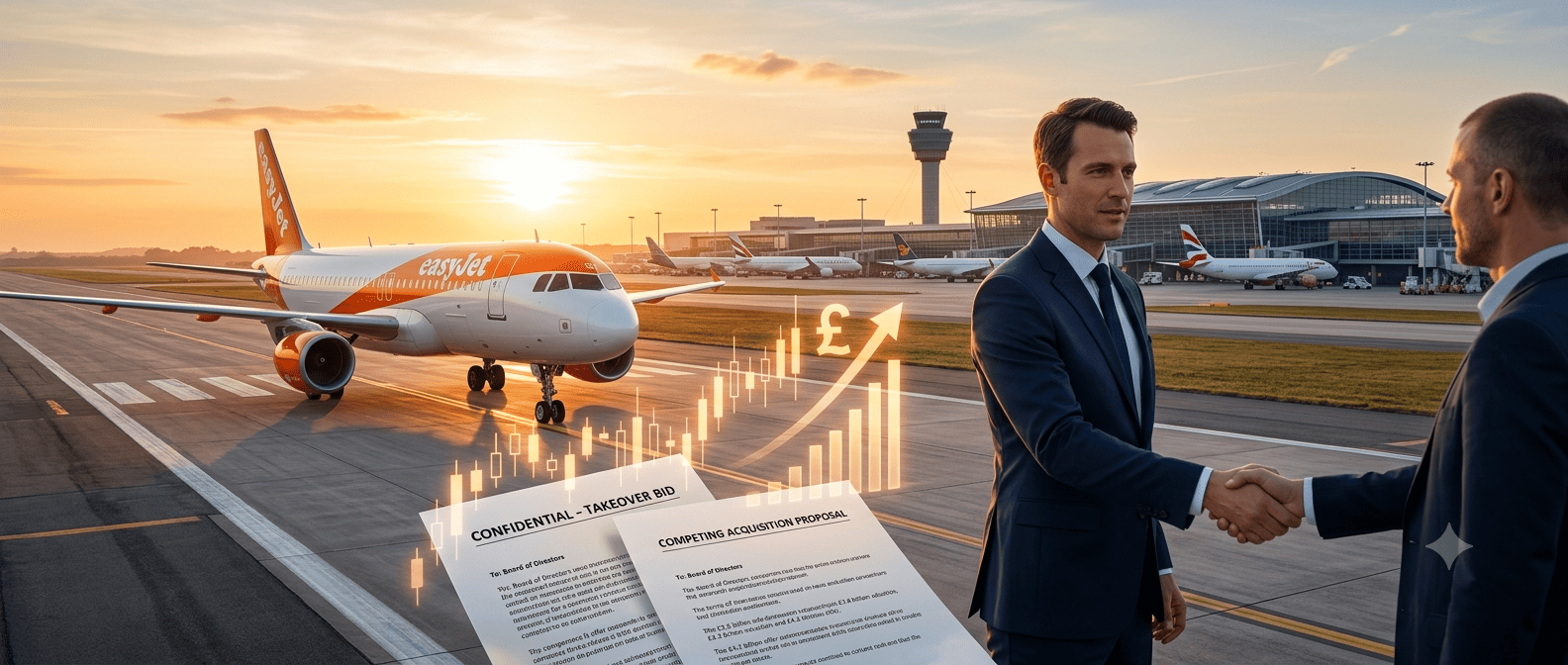
Apollo Global Management has entered a bidding war for EasyJet with a £5.7 billion offer, topping a rival bid from Castlelake. But what does this deal actually mean for the airline industry, investors, and the future of low-cost travel in Europe? This post breaks it all down.
What Is Happening? The EasyJet Takeover Explained
EasyJet, Britain's biggest budget airline, has become the center of a high-stakes acquisition battle. The story started in late May 2026, when US investment firm Castlelake publicly disclosed its interest in buying the airline. At the time, EasyJet's share price had fallen roughly 20% since the start of the year, driven by the US-Israeli war on Iran, which sent jet fuel prices sharply higher and forced the airline to issue two profit warnings.
Castlelake made five bids in total. EasyJet rejected the first four. The fifth, worth £6.90 per share and valuing the airline at £5.5 billion, was accepted "in principle" by EasyJet's board on July 5, 2026. EasyJet shares jumped nearly 10% on the news.
Then, on July 10, 2026, Apollo Global Management entered the picture with a superior all-cash offer of £7.15 per share, valuing EasyJet at £5.7 billion. EasyJet's board unanimously decided to support Apollo's offer instead, describing it as delivering "a superior outcome for easyJet shareholders." Apollo has until August 7 to make a firm offer, while Castlelake's deadline is August 3.
EasyJet operates 355 aircraft across 1,200-plus routes in 38 European countries, employs 19,000 people, and is headquartered at Luton Airport north of London.
Why Is This Happening?
Growing Interest in Stable Aviation Businesses
Despite recent turbulence from rising fuel costs, aviation remains one of the world's most dependable long-term businesses. Passenger numbers in Europe have recovered steadily since the COVID-19 pandemic, and demand for low-cost travel continues to grow. For private equity firms with long investment horizons, a temporarily undervalued airline is an attractive target.
EasyJet's valuable landing slots at airports including London Gatwick, Paris Charles de Gaulle, and Geneva make the airline particularly appealing. These slots are scarce and often cannot be replicated, giving any owner a durable competitive advantage.
Private Equity Looks for Long-Term Value
Both Castlelake and Apollo saw an opportunity created by short-term disruption. When a company's share price drops sharply due to external factors, such as a fuel shock caused by a geopolitical conflict, buyers can acquire it at a discount relative to its underlying value. This is sometimes called a "distressed asset" opportunity.
Castlelake, which specializes in lending to airlines and leasing planes to around 200 carriers globally, was also drawn to potential synergies with EasyJet's fleet. Apollo, one of the world's largest alternative asset management firms, has a broader focus on long-term value creation across many sectors.
Competitive Bidding Increases Value
Castlelake's first informal bid was rejected outright. Yet persistence paid off. By the fifth bid, EasyJet's board agreed. Apollo then stepped in with a higher offer, turning this into a competitive bidding situation. This dynamic is important from a business analysis standpoint. Once a company is publicly "in play," competing bids tend to emerge, driving the price higher and benefiting shareholders.
Strong Market Position
EasyJet is not a struggling airline. It faces stiff competition from Ryanair (Europe's biggest carrier), Wizz Air, and Jet2. But EasyJet's holidays arm has been a consistent bright spot, and its efficient Airbus fleet gives it a cost advantage. Apollo confirmed it has no intention of breaking up the company, stating it "believes in easyJet's existing strategy of evolving and strengthening the low-cost carrier model."
Impact of the EasyJet Takeover
Impact on Investors
For existing shareholders, this bidding war has been positive. Apollo's offer of £7.15 per share represents a 73% premium to EasyJet's share price on May 29, before Castlelake first disclosed its interest. EasyJet's founder, Stelios Haji-Ioannou, who still holds more than 15% of the company alongside his family, could receive close to £800 million from the deal.
Apollo's proposal also includes an unusual feature: existing shareholders will be allowed to remain invested under Apollo's ownership if they choose, rather than being forced to sell when the airline is delisted from the stock exchange. This gives investors more flexibility.
Impact on Customers
Apollo has signaled it intends to support fleet upgrades, grow EasyJet's loyalty and ancillary revenue streams, and expand the holidays business. In principle, this suggests a focus on improving the customer experience rather than cutting costs aggressively. However, private equity ownership typically brings a focus on profitability within a defined investment timeframe, so customers should watch for changes to pricing, routes, or service levels over time.
Impact on Competitors
A newly privatized EasyJet, backed by Apollo's capital, could emerge stronger and more competitive. Ryanair, Wizz Air, and Jet2 will be monitoring the situation closely. If Apollo invests in fleet modernization and holiday product growth as planned, EasyJet could close the gap with Ryanair on operational efficiency while differentiating itself through its holidays offering.
Impact on the Airline Industry
This deal is part of a broader trend of private equity entering aviation during periods of market weakness. It also reflects a wider wave of US investors acquiring undervalued London-listed companies. Britain is on course to set a mergers and acquisitions record in 2026, driven by a weaker pound and lower valuations compared to US markets. The EasyJet situation signals that no major European airline is fully insulated from acquisition interest.
Strategic Response
EasyJet's board, chaired by former Royal Bank of Scotland CEO Stephen Hester, has managed this process carefully. Rather than accepting Castlelake's early bids at what many analysts viewed as an insufficient price, the board held out for better terms. When Apollo entered with a superior offer, the board pivoted quickly and unanimously recommended it.
This is a textbook example of a board fulfilling its duty to shareholders: resisting pressure to accept undervalued bids, opening the door to competing interest, and ultimately securing a materially better outcome. Some analysts had criticized the board for accepting Castlelake's fifth bid too readily, suggesting the airline was worth more. Apollo's bid validated that view.
Future Outlook
Base Case
Apollo makes a firm offer before August 7, shareholders approve the deal, and EasyJet is taken private. Apollo invests in fleet upgrades and the holidays business over a 5 to 7 year holding period, then sells or relists the business at a higher valuation.
Upside Case
Castlelake improves its own offer before August 3, triggering a full bidding war. The share price rises further, delivering even greater returns to shareholders. Alternatively, Apollo's investment strategy succeeds faster than expected, with EasyJet's holidays arm growing into a high-margin business that significantly increases the airline's overall valuation.
Downside Case
The deal faces regulatory hurdles. European Union rules require airlines operating in the EU to be majority owned and controlled by EU nationals. Castlelake had planned to address this by holding only 49% of the bidding vehicle, with the remainder controlled by EU nationals. Apollo will likely need a similar arrangement. If regulators block or delay the deal, EasyJet's share price could fall sharply from current levels, leaving investors worse off than if no bid had been made.
Key Business Insights
Depressed share prices create acquisition windows. External shocks, like a fuel crisis, can temporarily reduce a company's market value well below its true long-term worth, attracting buyers.
Boards that hold out for fair value often attract better bids. EasyJet's repeated rejections of Castlelake's offers contributed to Apollo entering the process with a superior proposal.
Private equity is not always a threat. Apollo's stated intention to back EasyJet's existing strategy, retain its management, and invest in growth challenges the assumption that private equity ownership always leads to cost-cutting or asset stripping.
Regulatory complexity can make or break aviation deals. EU ownership rules add a layer of risk that does not exist in many other sectors.
Competitive bidding processes benefit shareholders. The gap between Castlelake's first informal bid and Apollo's current offer represents billions of pounds in additional value for investors.
Business Terms You Can Learn
Term | Simple Definition |
Private equity | Investment firms that buy companies using a mix of their own money and borrowed money, often taking them private to improve them before selling |
Takeover bid | An offer to buy a controlling stake in a company, usually at a premium to the current share price |
Premium | The extra percentage paid above a company's current share price in a takeover offer |
Delisting | When a company's shares are removed from a public stock exchange, usually as part of being taken private |
Mergers and acquisitions (M&A) | The process of companies combining (merging) or one buying another (acquiring) |
Asset-based lending | Lending money secured against physical assets, such as aircraft |
Market capitalization | The total value of a company's shares on the stock market |
Synergies | Benefits gained when two businesses combine, such as cost savings or shared resources |
Due diligence | The research a buyer does on a company before completing a purchase |
Bidding war | When two or more buyers compete to acquire the same company, each raising their offer |
What This Deal Teaches Us About Business
The EasyJet takeover story is still unfolding, but it already offers clear lessons. Companies with strong fundamentals, even those going through difficult periods, attract serious investor interest. Boards that act with discipline and patience tend to produce better outcomes for their shareholders. And the airline industry, often seen as cyclical and difficult, is capable of generating significant financial interest from sophisticated global investors when the conditions are right.
For students studying business, this case illustrates how macroeconomic events, like the fuel price surge from a geopolitical conflict, can reshape corporate valuations almost overnight. It also shows how the M&A process works in practice: from informal approaches, to board rejections, to competing bids, to regulatory challenges.
Watch the August deadlines closely. This story has further to run.