TL;DR: In June 2026, President Trump threatened a 100% tariff on goods from any country that taxes American tech companies with a Digital Services Tax (DST). Countries like the UK, France, Italy, and Spain are in the firing line. This post explains what is happening, why it matters, and what you can learn from it as a business student.
Taxing the internet sounds simple. A government sees that big tech companies like Google, Amazon, Meta, and Apple are making huge amounts of money from their citizens. So it wants a cut. That is the idea behind Europe's digital taxes. But those same taxes are now at the center of a major dispute over the Trump tariff on Europe.
But here is the problem. Those tech giants are American. And the Trump tariff on Europe is exactly how the US is pushing back. When the president sees a foreign country taxing American companies, he does not take it lightly. A simple tax decision quickly turns into a major international dispute.
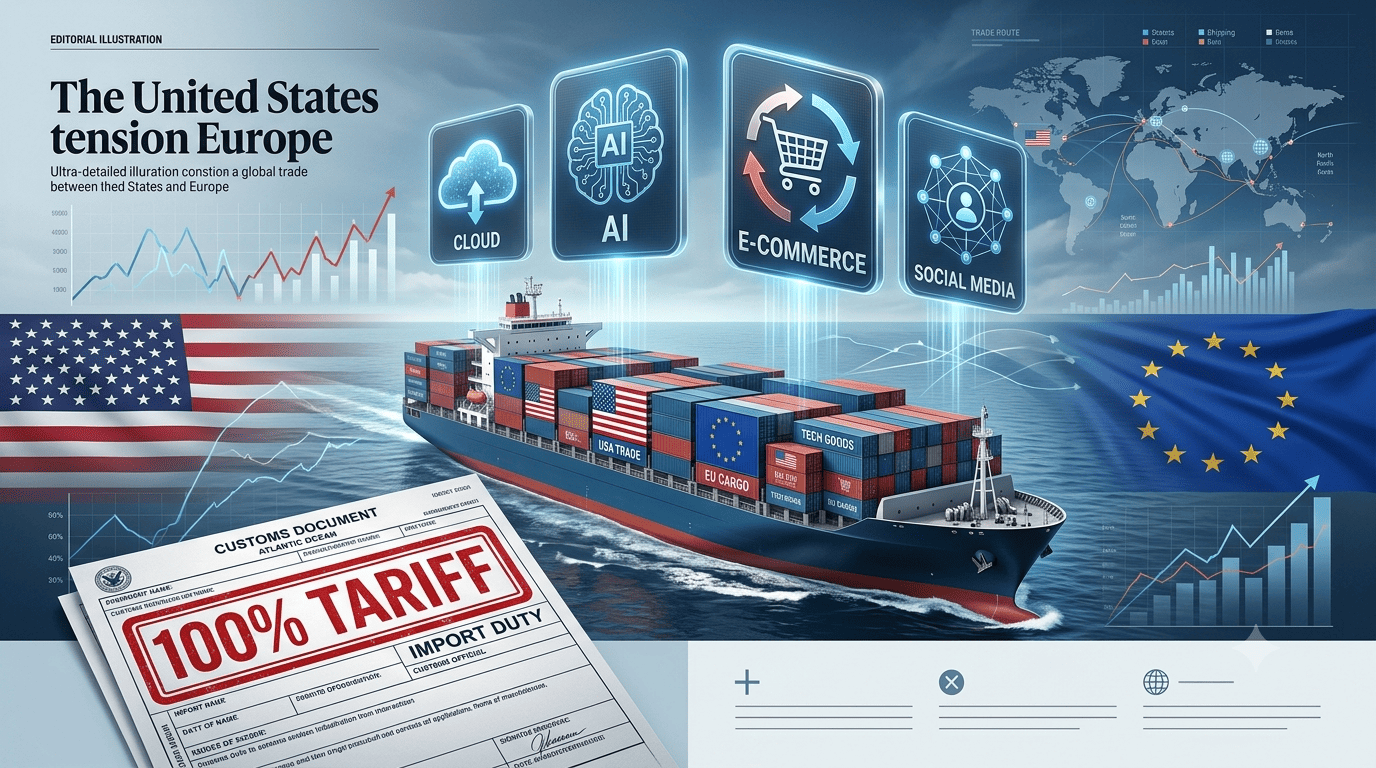
That is exactly what is happening right now. On June 26, 2026, President Trump posted a warning on Truth Social that put the Trump tariff on Europe front and center: any country that taxes American tech companies will face a 100% tariff on everything it sells to the US. Governments across Europe are worried. Trade tensions are rising fast.
Let us break it all down in plain language.
What Is Actually Happening?
Trump Tariff on Europe: The 100% Threat Explained
Trump posted this message on Truth Social:
"Numerous European Countries have been discussing the imminent implementation of a Digital Services Tax on American Companies. Some of these Countries are close to actually doing this. Please let this statement serve to represent that any Country that imposes such a Tax will immediately be met with a 100% TARIFF on any and all Goods sent to the United States of America."
So what does a 100% tariff actually mean? Let us use a simple example. Say a French wine producer sells a bottle for $20 in the US. With a 100% tariff, the American importer has to pay an extra $20 in taxes to the US government. The price doubles. Fewer people buy it. The French seller loses business. That is the whole point. The tariff is designed to hurt enough to force a change in behavior.
Trump also said this tariff would override any existing trade deals. Even countries that already have agreements with the US could lose their protections if they introduce a Digital Services Tax.
Which Countries Already Have a Digital Services Tax?
Several European countries already tax big digital companies:
United Kingdom: A 2% tax introduced in 2020. It applies to large platforms like search engines, social media sites, and online marketplaces. To qualify, a company must earn more than £500 million globally and more than £25 million from UK users. This tax raised £808 million in 2024-25. It directly hits companies like Apple, Google, Meta, and Amazon.
France: A 3% tax, often called the GAFAM tax (named after Google, Apple, Facebook, Amazon, and Microsoft), introduced in 2019. It applies to companies earning more than €25 million in France and €750 million globally. It raised around $700 million last year. French lawmakers even tried to double it to 6%, but that was blocked.
Italy and Spain: Both charge a 3% tax on large digital companies.
Austria: Has its own digital tax targeting big online platforms.
How Does This Fit Into the Bigger US-Europe Trade Story?
The timing here is very important. Trump's threat came just one day after the US and EU finalized a major trade deal. Under that deal, US tariffs on European goods were capped at 15%, and the EU agreed to drop its tariffs on American industrial goods to zero.
But the deal said nothing about Digital Services Taxes. And that gap has caused a huge problem.
The European Commission responded firmly: "Unilateral measures targeting such legitimate policies are unjustified. If pursued, the EU will respond swiftly and decisively to defend its rights."
Why Is This Happening?
Governments Want to Tax Big Tech
The idea behind Digital Services Taxes is about fairness. Traditional companies are taxed on the profits they make inside a country. But digital companies work differently. Google, for example, can earn billions in advertising money from UK users without having a big physical office or paying much tax in the UK. The DST is designed to fix that by taxing what these companies earn from local users, no matter where their profits are officially recorded.
It is both a money issue and a fairness issue. Small local businesses pay taxes. Why should the world's biggest tech firms pay almost nothing?
The US Disagrees
America sees this differently. The US is home to most of the world's biggest digital companies. So when a country taxes "large digital platforms," it mostly hits American businesses. The US Trade Representative's office has been arguing since at least 2019 that these taxes are unfair and deliberately target US firms. The Trump administration calls it economic nationalism: foreign governments trying to take money from American companies.
Tariffs as Pressure Tools
It is also worth knowing that Trump does not always follow through on tariff threats. He often uses them to pressure countries into changing their policies. Canada is a good example. It was planning its own digital services tax but dropped the idea in 2025 after the US threatened to walk away from trade talks. The threat alone was enough.
What Is the Business Impact?
On Tech Companies and Their Customers
Amazon has already felt the pressure. In 2026, it raised its seller fees by 3% in countries with digital taxes, saying the extra cost came from those taxes. For small businesses that sell through Amazon, this is a real hit. A policy dispute on the other side of the world is now costing them money.
Consumers could also end up paying more if companies decide to pass higher costs on to their customers.
On European Exporters
A 100% tariff would be very bad news for European businesses that sell goods in the US. The wine industry is the most talked-about example. France sells more than $2 billion worth of wine to the US every year. A 100% tariff would basically shut down that trade overnight.
But it is not just wine. Any business in a country with a digital tax could be affected. European governments are now stuck between two bad choices: keep collecting tech tax revenue or protect their traditional export businesses.
On Business Confidence
Even if the tariffs are never actually applied, the threat alone causes problems. Businesses start delaying big decisions. Investors get nervous. Contracts get renegotiated. Any time there is uncertainty in trade policy, it costs money, even before anything officially changes.
How Are Different Players Responding?
France: Staying Firm
French President Emmanuel Macron has been the most outspoken European leader. When asked on French TV if he would remove France's digital tax, he said simply: "No, because that is not how it works." He also said tariffs between wealthy G7 countries help no one. Even with Trump's direct threat against French wine exports, Macron has not backed down.
The UK: Playing It Carefully
The UK's position is less clear. Its digital tax has been in place since 2020. It is not yet certain whether Trump's threat applies to existing taxes or only new ones. According to the BBC, the UK government is already quietly exploring changes to its digital tax to reduce the risk of US retaliation.
Canada: Chose to Back Down
Canada gives us a useful comparison. When the US applied similar pressure, Canada chose to shelve its planned digital tax in 2025. It shows the tariff threat can work without a single tariff being imposed.
Tech Companies: Stuck in the Middle
American tech companies like Apple, Google, Meta, and Amazon benefit if these taxes disappear. But they cannot say so too loudly. If they are seen actively lobbying against European taxes, it could damage their image and their relationships with European customers and regulators.
What Could Happen Next? Three Possibilities
Most Likely: Ongoing Tension
The most probable outcome is that this dispute drags on. Some countries may quietly lower or remove their digital taxes. Others, like France, will hold firm. The UK will likely make small adjustments to keep the peace. There will be no clean ending anytime soon.
Best Case: A Global Tax Agreement
The OECD has been working on a global minimum tax deal for years. If that progresses, countries could replace their individual digital taxes with one agreed international system. That would remove the US objection that these taxes unfairly target American companies.
Worst Case: A Full Trade War
If Trump goes ahead and applies 100% tariffs on a country like France, the EU will likely hit back with its own tariffs on American goods. Both sides would suffer. Prices would rise. Supply chains would be disrupted. Businesses on both sides would face losses.
Key Business Words Explained
Here are the important terms from this story, explained simply:
Tariff: A tax that a government charges on goods coming in from another country. A 100% tariff means the price of imported goods doubles.
Digital Services Tax (DST): A tax on the money that large digital companies earn from users in a specific country, no matter where the company is based.
Levy: Just another word for a tax or charge.
Punitive: Something designed to punish. A 100% tariff is punitive because its goal is to hurt the other side into changing their behavior, not to raise money.
Supersede: To replace or override something. Trump said his tariff would supersede existing trade deals.
Bilateral Trade Agreement: A trade deal between two countries or groups, like the US and EU, that sets rules on tariffs and trade between them.
Retaliation: When one country responds to another's action with a counter-action. The EU warned it would retaliate if Trump applied tariffs.
Economic Nationalism: When a government puts its own country's industries and businesses first, even if that means limiting free trade with other countries.
Key Business Lessons
This story teaches some important lessons about how business and politics connect:
Government policy affects your business. A political decision made in Washington can raise the costs of a small seller on Amazon in London. Businesses need to watch policy changes, not just market trends.
Threats are tools. A 100% tariff threat changes how everyone behaves, even if it is never actually applied. The threat itself has power.
Different groups have different interests. US tech companies, European governments, exporters, small businesses, and consumers all want different things from this dispute. Understanding who wants what helps you understand why decisions get made.
Trade deals have limits. The US and EU signed a big trade deal just one day before this tariff threat. Yet the threat immediately raised doubts about that deal. Agreements only cover what they explicitly say.
History gives you clues. The US has been threatening digital tax retaliation since 2019. Knowing the backstory helps you predict what might come next.
The Bigger Picture: Who Actually Pays?
Trump's tariff threat is not just about taxes. It reflects a deeper question that the world has not yet answered: how should governments tax companies that make money digitally, whose profits can be moved anywhere, and whose customers are everywhere?
European governments say they just want big tech to pay a fair share locally. The US says its companies are being unfairly targeted. Both sides have a point. Neither has found a solution that works for everyone.
For now, the dispute continues. And as is usually the case in trade conflicts, the costs will likely fall on ordinary businesses and consumers, the people who had no part in starting the fight.