Wimbledon Strawberries: Business Lessons in Supply Chain Management Every Student Should Know
Every summer, Wimbledon serves millions of strawberries to fans from around the world. It looks like a simple tradition. But behind every punnet of berries is a carefully planned supply chain management system, a trusted supplier who has been on board for nearly 30 years, strict quality checks, and a brand built over more than a century.
For business students and anyone who wants to learn how businesses work, this is more than just a sports tradition. It is a real-life example of supply chain management in action. And the lessons here apply to any business, big or small, in any industry.
Key Takeaways
Consistency builds stronger brands than advertising alone.
Reliable suppliers reduce business risk and enable innovation.
Strong logistics keep operations running and customers satisfied.
Climate change is a real and growing threat to business strategy.
Small operational details are what separate premium brands from average ones.
What Happens Behind the Scenes: Wimbledon's Supply Chain in Numbers
Before diving into the business lessons, here is what actually takes place each year.
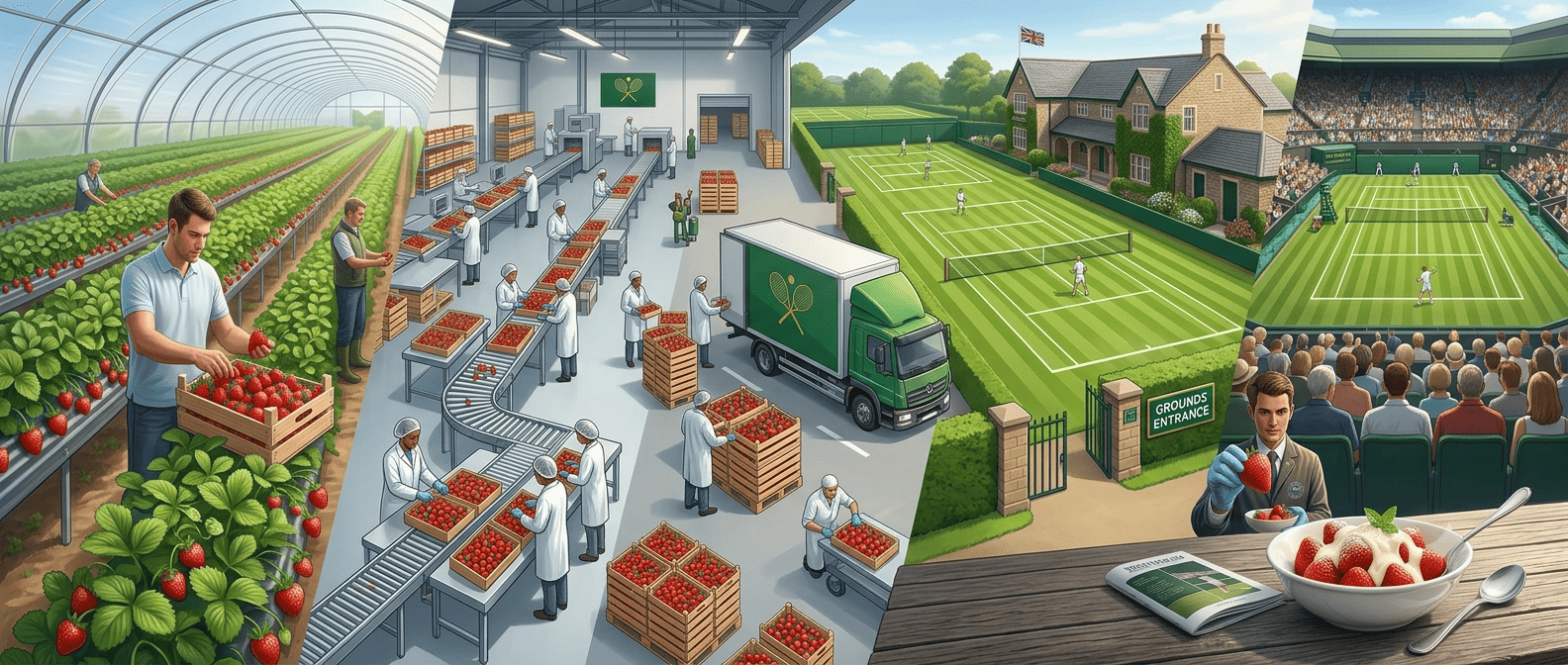
During the 2024 Wimbledon Championships, the All England Club served over 55 tons of strawberries, totaling more than 2.5 million Grade 1 berries, paired with 13,241 liters of cream. That produced 251,405 individual portions (Forbes, July 2025).
Every strawberry came from one place: Hugh Lowe Farms, a family-run business in Mereworth, Kent, just 31.5 miles from the club. The farm has been Wimbledon's sole strawberry supplier for nearly 30 years.
Each morning during the tournament, a crew of at least 20 workers picks the berries by hand at sunrise. The strawberries must arrive at the All England Club for inspection and hulling by 9 a.m. and are served to fans that same day. Any berry that does not meet the standard gets frozen and later sold as jam at the venue.
To meet this demand, the farm plants 100,000 new strawberry plants every March. It grows a single variety called Mailing Centenary, chosen for its uniform shape, natural sweetness, and ease of picking. Working alongside Vodafone as an official Wimbledon partner, the farm also uses IoT (Internet of Things) sensors to track temperature, vibration, and humidity throughout the delivery process.
Wimbledon runs 55 kitchens on site and is the largest single annual sporting catering operation in Europe. In 2024, no food was transported to the venue by air, reflecting a commitment to local sourcing.
Business Analysis: 5 Supply Chain Management Lessons from Wimbledon
1. Brand Equity Is Built Through Consistency, Not Campaigns
Wimbledon does not serve strawberries because they are the cheapest option or the most nutritious. They serve them because fans expect them, and that expectation has been built over nearly 150 years.
This is what brand equity really means: the extra value a brand holds in the minds of customers because of trust, familiarity, and emotional connection. Wimbledon's strawberries are worth far more than their ingredient cost because they carry the weight of tradition and identity.
The lesson for any business is this: brand strength does not come from one great campaign. It comes from delivering the same quality promise, over and over again. A coffee shop that makes an excellent flat white every single morning builds more long-term trust than one that occasionally makes the best coffee in the city. Consistency beats occasional brilliance.
2. Supply Chain Management Creates Customer Value
Most customers never think about supply chains. They see a bowl of strawberries and cream, and they enjoy it. They do not consider the 20 pickers who started at dawn, the 31.5-mile drive, the quality inspection, or the IoT sensors monitoring temperature in transit. But all of that invisible work is what makes the customer moment possible.
Supply chain management is the set of processes that transform raw inputs (strawberry plants, soil, labor, and logistics) into finished customer experiences. Every link in the chain matters. If the berries ripen a day too early, quality drops. If the delivery is late, the kitchen cannot serve on time. If quality checks are skipped, customers notice.
Wimbledon's supply chain focuses relentlessly on freshness: picked in the morning, served by afternoon. That single-minded focus on one quality dimension is a deliberate strategic choice. It also reinforces the brand promise, that what you are eating is real, local, and fresh.
Business lesson: Identify which part of your supply chain most directly drives customer satisfaction. Then protect that part relentlessly.
3. Long-Term Supplier Partnerships Reduce Risk and Enable Innovation
Hugh Lowe Farms has supplied Wimbledon for nearly 30 years. That is not a coincidence. It is a strategic decision.
Long-term supplier relationships reduce uncertainty, improve communication, and create shared investment in quality. When a business switches suppliers frequently to chase lower prices, it often pays hidden costs: inconsistent quality, time lost onboarding new vendors, and the risk of catastrophic failure when a new supplier cannot deliver.
This relationship also drives innovation. The adoption of IoT tracking technology was a joint effort between Hugh Lowe Farms and Vodafone, made possible because of the trust built over years of partnership. That kind of collaborative improvement rarely happens with suppliers you have just met.
Business lesson: Long-term partnerships are an underrated competitive advantage. Reliable supplier relationships are often worth more than the cheapest available price.
4. Climate Risk Is Now a Business Risk
Strawberries are one of the most climate-sensitive crops in agriculture. A temperature rise of just 1 to 2 degrees Celsius can reduce strawberry yields by up to 28% (ClimateAI, 2026). Hail alone can cosmetically damage up to 80% of a crop, making most of it unsellable in premium markets. Late frosts, prolonged droughts, and unseasonal heat all carry serious risks.
For Wimbledon's supply chain, this means that a system which has worked reliably for three decades now faces threats it did not encounter in the same way a generation ago. A bad summer in Kent could significantly reduce supply. A frost during the flowering stage could eliminate an entire planned harvest.
This challenge extends well beyond agriculture. Fashion brands dependent on cotton, construction firms managing outdoor timelines, and logistics companies moving goods through extreme weather all face the same question: what happens to our supply chain when climate conditions shift?
Business lesson: Risk management must now include long-range environmental thinking. Businesses that prepare for climate-related disruption will be more resilient than those that wait and react.
5. Small Details Define Premium Brands
The choice of a single strawberry variety (Mailing Centenary) is not an accident. It was selected for its uniform shape, bright red color, natural sweetness, and ease of picking. Each of these qualities serves the same purpose: making the product look and taste as good as possible, every time.
This is the logic of premium positioning. Premium brands do not just deliver good products. They control the details that most competitors ignore: the specific variety of berry, the delivery window, the presentation. Each small decision shapes the customer's overall perception of quality, often without the customer being able to explain why something feels better.
Business lesson: Details are not optional extras in a premium business. They are the product.
Business Terms to Know
Supply Chain Management refers to the process of coordinating all activities involved in sourcing, producing, and delivering a product to the customer. At Wimbledon, this spans from planting strawberry crops in March all the way to serving portions at courtside in July.
Logistics is the practical coordination of moving goods from one location to another efficiently and on time. For Hugh Lowe Farms, logistics means delivering 55 tons of fresh strawberries from Kent to London every morning of the tournament in peak condition.
Quality Control is the process of checking that a product meets defined standards before it reaches the customer. Wimbledon uses Grade 1 certification for all berries served. Every delivery is inspected before hulling begins.
Brand Equity is the additional value a brand holds in customers' minds because of trust, recognition, and emotional association. Wimbledon strawberries cost more than supermarket berries partly because of the experience and tradition tied to the name.
Risk Management involves identifying potential threats to a business and preparing strategies to reduce their impact. For Wimbledon's supply chain, key risks include climate disruption, harvest failure, and single-supplier dependency.
Customer Experience is the total impression a customer forms from every interaction with a brand or product. Eating strawberries and cream at Wimbledon is not simply consuming food. It is participating in a tradition, which is why fans are willing to queue for hours for one portion.
Business Impact
For consumers: The tradition creates a premium experience that is hard to replicate elsewhere. The perceived value of Wimbledon strawberries is far higher than their ingredient cost because of the context in which they are consumed. This is a clear example of how experience shapes perceived value.
For businesses: The Wimbledon model shows how strategic supplier relationships, local sourcing, and quality-first logistics can produce a product that commands premium pricing and generates lasting brand associations. It also demonstrates that even long-established operations need to keep investing in technology to maintain standards at scale.
For agriculture: The Wimbledon supply chain highlights both the opportunity and the vulnerability of supplying premium markets. A long-term contract with a prestigious client like the All England Club brings reliable demand and strong reputational benefits. But it also raises the stakes for failure. Any shortfall in quality or supply carries serious consequences, including damage to a partnership built over decades.
Future Outlook
Base case: Hugh Lowe Farms continues its established relationship with Wimbledon, gradually integrating more precision agriculture technology to manage climate and yield risks. The tradition continues, and steady operational improvements keep quality consistent year on year.
Upside case: IoT monitoring, improved growing techniques, and sustainable farming practices allow Hugh Lowe Farms to increase yield reliability while reducing its environmental footprint. The farm becomes a widely cited model for how traditional agriculture can modernize, attracting additional premium partnerships beyond Wimbledon.
Downside case: Worsening climate conditions in southern England reduce harvest reliability. A severe frost, prolonged drought, or extreme heat event during the critical growing window creates a significant supply shortfall. Wimbledon is forced to source from alternative suppliers at short notice, disrupting a tradition that has taken over a century to build. Rising input costs and water constraints add further financial pressure at the farm level.
The downside scenario is not hypothetical. ClimateAI (2026) confirms that strawberry farming is one of the most climate-sensitive segments in agriculture, with key growing regions facing rising temperatures and more frequent extreme weather events.
Key Business Insights
Consistency creates brand equity. Delivering the same quality experience, over and over, builds more trust than occasional excellence.
Supply chains are invisible until they fail. The best operations are the ones customers never have to think about because everything simply works.
Long-term partnerships are a strategic asset. Stable supplier relationships reduce risk, enable innovation, and improve quality over time.
Climate risk is business risk. Any operation that depends on agriculture, outdoor activity, or seasonal inputs needs a climate risk strategy built into its planning.
Details define premium brands. Choosing a single strawberry variety shows that premium positioning is built on specificity and control, not generality.
Technology extends tradition. IoT sensors and cloud-based crop monitoring do not threaten a 150-year-old tradition. They protect it.
Conclusion: What a Bowl of Strawberries Can Teach You About Business
It is easy to look for business lessons in billion-dollar startups or major tech disruptions. But some of the most useful case studies are much closer to everyday life. A farm in Kent. A delivery window that closes at 9 a.m. A single strawberry variety selected for its shape and sweetness. A supplier partnership maintained for three decades.
Wimbledon's strawberry operation brings together supply chain management, brand equity, quality control, and risk strategy — all wrapped up in something that looks, on the surface, like a simple sporting tradition.
The next time you think about consistency, supplier relationships, or business risk, you might find that the clearest example starts with something as humble as a strawberry. Look for the operational detail behind the polished experience. That gap is where most of the real business learning lives.