Quick answer: World Cup hospitality jobs were forecast to surge in June 2026 — Goldman Sachs alone projected a 40,000-job gain. Instead, the leisure and hospitality sector shed 61,000 jobs, according to the US Bureau of Labor Statistics. A combination of weaker international tourism, front-loaded May hiring, immigration deterrence, high ticket prices, and a soft US labor market all contributed to the shortfall.
The world's biggest sporting event arrived in the United States on June 11, 2026. Fifty-six million fans were expected to follow along. Host cities had been promised packed hotels, booming restaurants, and a surge of new jobs. Economists and government officials talked up the tournament's economic potential for months.
Then the June employment report landed.
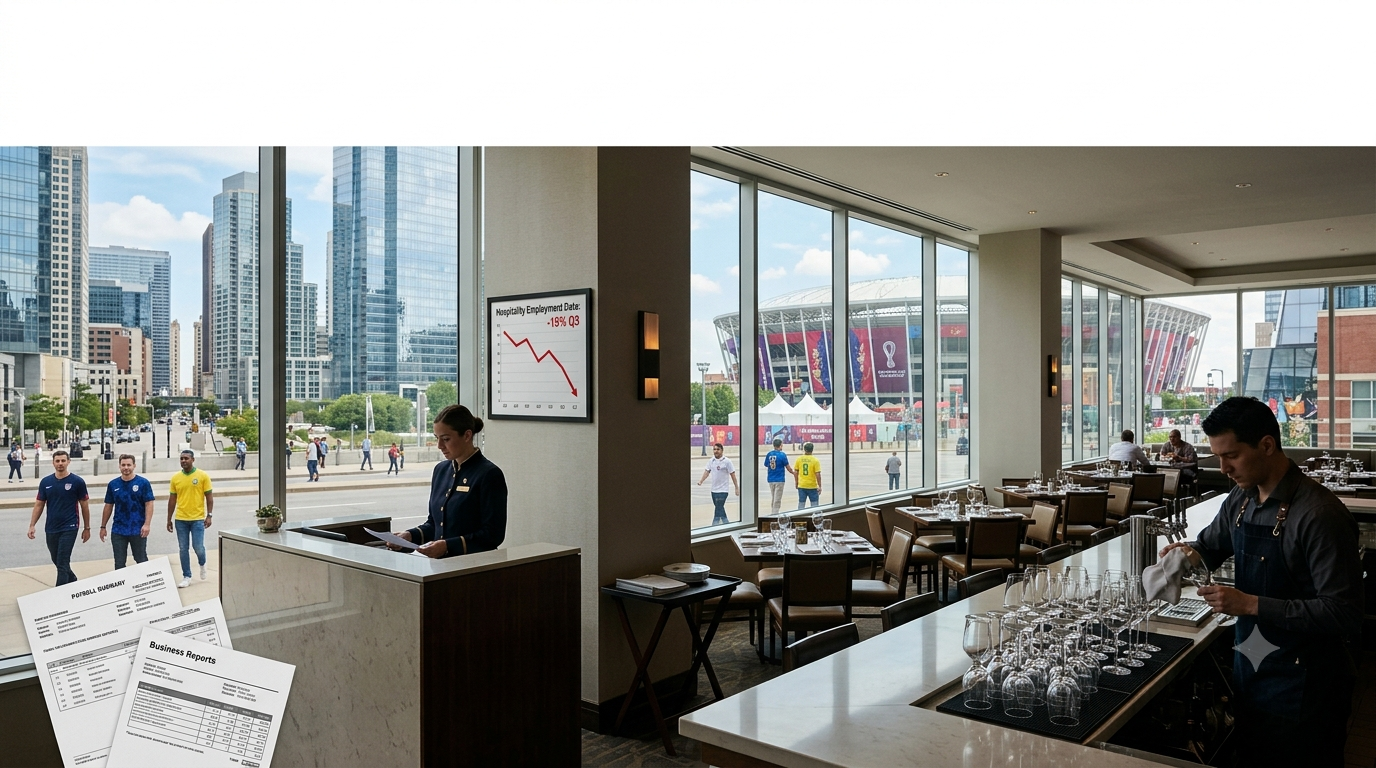
Released by the US Bureau of Labor Statistics (BLS) on July 2, 2026, the data told a very different story. The leisure and hospitality sector, which includes hotels, restaurants, and bars, lost 61,000 jobs during the month the tournament began. Total US job creation came in at just 57,000 for June, roughly half of the 115,000 forecast by Dow Jones consensus estimates.
This analysis breaks down what the data shows, why the jobs boom failed to materialize, what it means for different groups, and what business students and learners can take away from it.
What Did the June 2026 Employment Report Reveal About World Cup Hospitality Jobs?
Here is a summary of the key numbers from the BLS report (released July 2, 2026):
Metric | Result | Forecast / Prior |
Total jobs added (June 2026) | 57,000 | Forecast: 115,000 |
Leisure and hospitality jobs | -61,000 | Goldman Sachs forecast: +40,000 |
Unemployment rate | 4.2% | Down from 4.3% in May |
Labor force participation rate | 61.5% | Lowest since March 2021 |
Average hourly earnings (YoY) | +3.5% | Inflation: above 4% |
May 2026 jobs (revised down) | 129,000 | Originally reported as 172,000 |
May hospitality jobs (revised down) | 40,000 | Originally reported as 70,000 |
A few numbers stand out. The unemployment rate actually fell, but not because more people found work. It fell because fewer people were actively looking for jobs, which brought the labor force participation rate down to its lowest point since March 2021. That is an important distinction. A falling unemployment rate is usually good news. Here, it partly reflects discouragement.
The 3-month average for leisure and hospitality also tells a clear story: the sector shed an average of 9,000 jobs per month over the previous three months, compared to gains of about 13,000 per month in the 12 months before that. The trend was already weakening before June hit.
EY-Parthenon chief economist Gregory Daco called the hospitality plunge "the biggest black eye" in a lackluster report. "The labor market is stuck in second gear," he said.
White House Economic Council Director Kevin Hassett described the data as "a little bit of a puzzle," adding: "The people who would be doing the travel and leisure support of all those fans who are in the country, somehow their employment went down. That doesn't make a whole lot of sense to us."
Why Did the World Cup Jobs Boom Fail to Materialize?
The answer is not a single cause. Several forces worked together to undercut what should have been a strong hiring period.
Did businesses hire early, before the tournament started?
Yes, and this matters a great deal. Hospitality job postings in the 11 US host cities rose 30.3% in May compared to the January-to-April average, according to Kelly Services. Philadelphia led at 83%, followed by Boston at 61%, Atlanta at 55%, Houston at 54%, and Dallas-Fort Worth at 40%.
This suggests many hospitality businesses front-loaded their hiring before the first match kicked off. When the revised May hospitality figures came in at 40,000 jobs (down from the originally reported 70,000), it pointed to a burst of early-stage hiring that was then corrected in June as demand proved weaker than expected.
Jim Baird of Plante Moran Financial Advisors put it plainly: "Many had forecast additional hiring needed to support the draw of travelers from abroad and within the US flocking to World Cup venues. That either didn't materialize or was more than offset by losses elsewhere."
Was international tourism weaker than expected?
Significantly weaker. Before the tournament, 80% of hotel bookings across host cities came in below expectations, with 70% of hospitality businesses citing visa barriers and geopolitical uncertainty as the main reasons for weaker demand, according to the American Hotel and Lodging Association.
In New York City, which hosts the final on July 19, bookings sat at roughly 65% of what operators had expected. Seattle reported that 80% of hotels were lagging behind typical summer booking levels, not even accounting for the World Cup bump that FIFA had projected.
The US Travel Association data showed that domestic travelers made up nearly 70% of all flight bookings to World Cup games. International visitors, who typically spend more than $5,000 per trip (around $200 more than domestic visitors, on average), were a much smaller share. Canada accounted for only about 6% of bookings. The UK made up 4.8%.
Did immigration policy play a role?
A clear one. The American Civil Liberties Union (ACLU) issued a formal travel advisory in April 2026 warning foreign visitors that "rising authoritarianism and increasing violence pose serious risk." Visa processing delays meant some international fans could not secure entry in time. An earlier $15,000 visa bond requirement for visitors from 50 countries, though later waived for ticket holders, created confusion and deterred potential travelers.
NerdWallet senior economist Elizabeth Renter noted: "The labor force is aging and immigration policies have stymied a major source of continued labor force growth. These labor supply issues can act as a drag on the economy."
Were ticket prices a factor in suppressing demand?
Ticket prices were widely criticized as prohibitive. Average resale prices for early-round games in Dallas ran above $800 for nosebleed seats. Final match tickets on Ticketmaster started at roughly $9,200 and reached as high as $43,553. This is more than seven times the cost of tickets for the 2022 World Cup in Qatar. Many fans, particularly from lower-income countries with strong football cultures, simply could not attend.
What about broader economic pressures on consumers?
Gas prices reached $4.16 per gallon in June 2026, up sharply from $2.98 per gallon in late February. Real wages were declining: average hourly earnings rose 3.5% over the past year, but inflation remained above 4%. Consumers were squeezed. The Conference Board survey showed the share of people saying jobs are "hard to get" jumped 22.5% in June. People were spending more carefully on essentials, leaving less room for discretionary travel.
How Did This Affect Different Groups?
Hospitality businesses
The impact was uneven. Operators in some host cities saw genuine activity. Dallas-based rideshare company Alto hired hundreds of new drivers per week during the tournament. American Airlines added more than 28,000 domestic seats in direct response to demand. Flight bookings to Houston and Dallas surged 38% and 42% respectively compared to the same period a year ago, according to market analytics firm Sojern.
But many restaurant and hotel operators held off on hiring, waiting to see whether crowds would actually show up before committing to staff. A downtown Los Angeles restaurant owner told Marketplace she chose not to hire despite having a FIFA partnership. Several Houston restaurant owners made the same call.
Workers
Stadium workers at SoFi Stadium in Los Angeles, represented by Unite Here Local 11, came close to striking before the opening match. They ultimately reached a deal on June 9 that brought most workers above $40 per hour, with tip workers receiving at least a 30% pay increase. For many frontline hospitality workers elsewhere, however, wage growth continued to trail inflation, meaning real purchasing power fell even as nominal pay rose.
The US economy overall
The broader labor market showed clear signs of strain. Labor force participation hit its lowest level since March 2021. The ADP private payroll report showed 98,000 jobs added for the month, broadly consistent with the BLS figure. Job openings data showed that people who had jobs were not leaving for new ones, suggesting declining confidence in the market.
Despite the weak jobs report, US stock markets moved upward on July 2. The Nasdaq and S&P 500 each gained 0.6%, and the Dow climbed 0.8%. Gold jumped 2%. Markets interpreted the soft data as a signal that the US Federal Reserve would not raise interest rates in the near term, which investors viewed as broadly supportive for asset prices.
Business Terms You Should Know
Term | Simple Explanation |
Labor force participation rate | The percentage of adults who are either working or actively looking for work. A fall means more people have stopped looking. |
Front-loading | Doing something earlier than needed, like hiring staff before demand actually arrives. |
Seasonal adjustment | A statistical method used to remove predictable seasonal patterns from data, making month-to-month comparisons more meaningful. |
Substitution effect | When spending on one thing (e.g., World Cup tickets) replaces spending on something else, rather than adding to total spending. |
Consensus forecast | The average prediction made by a group of economists or analysts before data is released. |
Labor supply constraint | A situation where there are not enough available workers to fill open jobs. |
Real wages | Wages adjusted for inflation. If pay rises 3.5% but prices rise 4%, real wages have actually fallen. |
U-6 unemployment rate | A broader measure of unemployment that includes discouraged workers and people working part-time who want full-time work. |
How Should Hospitality Businesses Respond?
For operators in and around World Cup host cities, the practical lessons from the June data are worth acting on now:
Watch local data, not just national. The BLS will release metro-area employment data for June later this month. Host city numbers may tell a more positive story than the national aggregate. Business decisions should be based on local demand signals.
Use flexible staffing structures. The gap between expected and actual demand underlines the cost of over-hiring too early. Businesses that used on-call or temporary workers, rather than bringing on permanent staff, were better positioned when demand came in below projections.
Track spending, not just footfall. Even in cities where fan attendance was strong, local tax receipts and retail spending data will provide a clearer picture of whether the economic activity was real or concentrated in a narrow segment. Axios noted these figures are worth watching closely.
Factor in wage cost increases. The SoFi Stadium agreement sets a new benchmark for what large-event hospitality workers expect. Any hospitality business planning to staff up for future major events needs to price that into labor cost projections.
What Happens Next? Three Scenarios
Base case: slow stabilization
Goldman Sachs projected that hospitality payrolls would add around 10,000 jobs in July as the tournament continues, then shed 15,000 in August as temporary positions end. This pattern would be broadly consistent with what happened after previous major sporting events. The US economy would continue adding jobs at around 90,000 to 100,000 per month on average, enough to hold unemployment steady but not enough to signal a rebound.
Upside scenario: late-tournament surge
If the knockout rounds draw larger domestic crowds and hotel bookings recover in July, particularly in cities hosting quarterfinals, semifinals, and the July 19 final near New York, the leisure and hospitality sector could recover some of the June losses. Airbnb CEO Brian Chesky told investors during the company's Q1 2026 earnings call that the company expected more bookings for the tournament than for any event in its history. If those bookings convert to actual stays, July data could look meaningfully better.
Downside scenario: structural weakness persists
If labor force participation continues to fall, if real wages keep declining, and if immigration restrictions continue to constrain labor supply growth, the hospitality sector may struggle to recover even as the tournament winds down. S&P Global Market Intelligence concluded before the tournament began that the World Cup was unlikely to produce a measurable effect on national economic data. June's numbers suggest they were right.
What Can Business Students Learn From This?
This story is a useful case study in several foundational business and economics concepts.
Forecasts are not guarantees. Goldman Sachs, FIFA, the White House, and the Dow Jones consensus all predicted something that did not happen. Data revisions also show that even what we think happened (the May surge) was partly an overcount. Numbers get revised. Decisions based on a single forecast are risky.
Demand is shaped by many variables at once. Ticket prices, visa policies, gas prices, consumer confidence, and immigration rules all worked against the jobs boom simultaneously. No single factor explains the miss. That is how most real business problems work.
Macro trends affect micro decisions. Individual restaurant owners and hotel managers made rational choices to hold off on hiring because they read the demand signals correctly. They were not wrong to be cautious. Good operators watch conditions closely and respond to actual data, not projected data.
Substitution effects are easy to underestimate. When a major event draws spending from people who would have spent money in the local economy anyway, the net new economic activity is much smaller than headline visitor numbers suggest. This is why S&P Global was skeptical of the boom thesis from the start.
Key Insights
The US added only 57,000 jobs in June 2026, less than half of the 115,000 consensus forecast (Source: BLS, July 2, 2026)
Leisure and hospitality shed 61,000 jobs, the opposite of Goldman Sachs' projection of a 40,000-job gain
Labor force participation fell to 61.5%, its lowest level since March 2021
80% of hotel bookings in host cities came in below expectations before the tournament began
Domestic travelers made up 70% of flight bookings to World Cup games; international fans who tend to spend more were underrepresented
Real wages fell: average hourly earnings rose 3.5% over the year, but inflation stayed above 4%
S&P Global had predicted before the tournament that World Cup hosting would produce no measurable impact on national employment data; June results appear to support that view
The Bigger Picture: What This Tells Us About Mega-Event Economics
The World Cup is still happening. Fans are in the stadiums. Bars are crowded on match days. The anecdotes are real. Scotland fans reportedly drank Boston bars dry ahead of their team's June group matches.
But anecdotes and employment data often point in different directions. The national numbers for June 2026 are a reminder that even the world's biggest sporting event is small relative to the scale of the US economy. When visa barriers reduce international arrivals, when ticket prices push domestic fans to watch from home, and when businesses hire cautiously rather than speculatively, the math changes fast.
For business learners, this episode is a masterclass in the gap between expected outcomes and measured outcomes. Large sporting events generate real spending. They also generate real substitution, real displacement, and real uncertainty. The businesses and analysts that did best in June were the ones that kept their plans flexible and waited for actual demand before committing to costs.
The tournament continues through July 19. Local employment and retail data for June will give a more detailed picture when metro-area figures are released later this month. The full story is not over. But the June national employment report has already told us something important: the promised jobs boom, at least at the macro level, was a head fake.