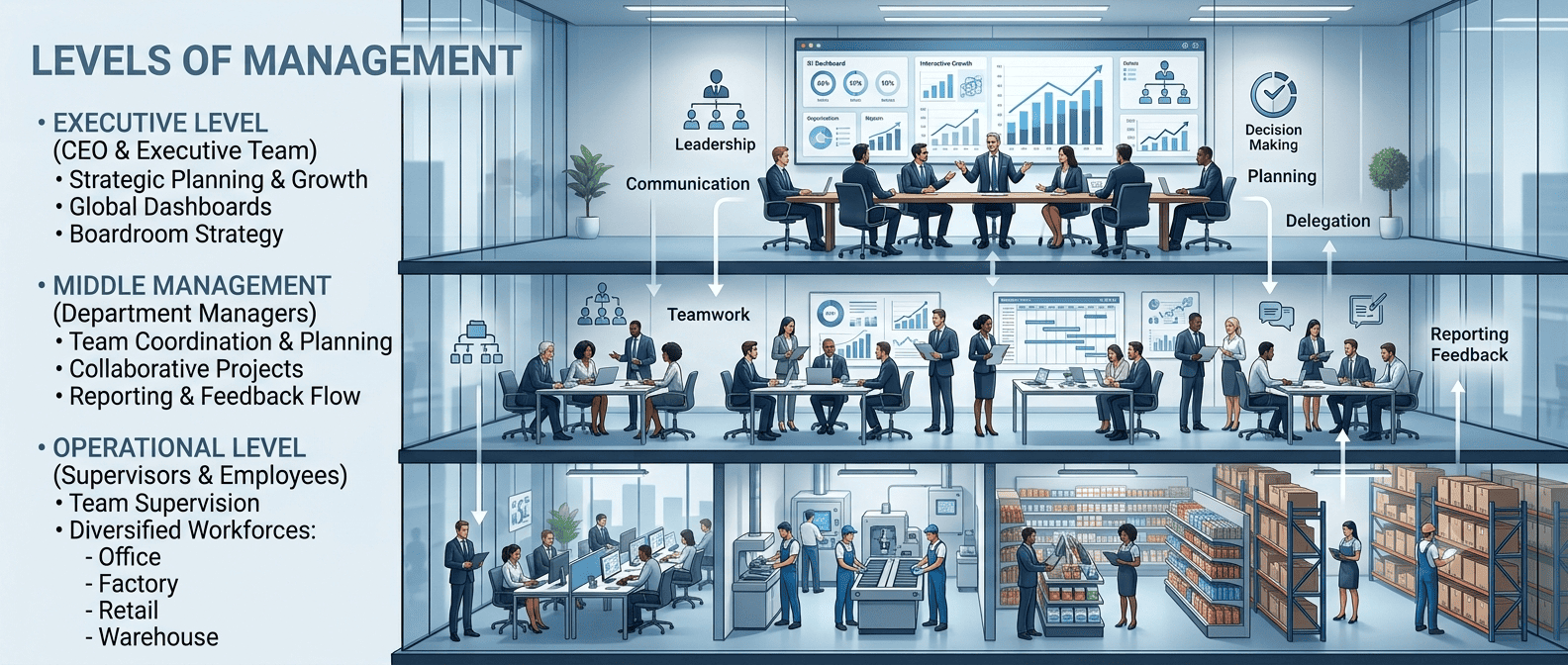
Every business, from a small local store to a global corporation like Apple, needs people who can plan, direct, and make sure the right things get done. Without a clear structure, tasks fall through the cracks, goals get missed, and teams lose direction. That is where the levels of management come in.
Understanding the levels of management helps you see how a company actually works from the inside. Whether you are a student studying business or someone starting your career, knowing how decisions flow through an organization gives you a major advantage. This guide breaks it all down in plain language, with real examples to make it stick.
What Are Levels of Management?
Levels of management refer to the layers of leadership within an organization, each responsible for a different set of tasks and decisions. According to the American Management Association, it is commonly accepted that there are three management levels: top, middle, and lower management.
Think of it like a pyramid. People at the top make the big calls. Those in the middle translate those calls into action plans. Those at the bottom make sure the actual work gets done every day.
Why Does This Structure Matter?
Without a clear structure, a business becomes chaotic. Every person would make decisions on their own, pull in different directions, and waste time on work that does not align with the company's goals.
A well-defined management structure solves that problem. It creates order. It ensures that a company's big vision gets broken down into real, day-to-day actions. It also makes communication cleaner, because each level knows who to report to and who to listen to.
The Three Levels of Management Explained
Top-Level Management
This is the highest level of authority in any organization. Top-level managers include titles such as Chief Executive Officer (CEO), Chief Operating Officer (COO), Chief Financial Officer (CFO), Managing Director, President, Vice President, and members of the Board of Directors.
These leaders do not manage day-to-day tasks. Their job is to set the vision, define the long-term goals, and decide where the company is headed. They focus on big-picture thinking: which markets to enter, how to position the brand, and how to respond to competition or economic change.
Key responsibilities include:
Setting company-wide goals and strategic direction
Making major financial decisions
Managing relationships with investors and external stakeholders
Overseeing and guiding middle management
Real-world example: When Apple's CEO Tim Cook decides to invest heavily in artificial intelligence or launch a new product line, that is top-level management at work. He is not writing a single line of code or designing any hardware. He is shaping the future of the entire company.
Middle-Level Management
Middle managers sit between top leadership and the employees who carry out daily tasks. Common titles include Department Head, General Manager, Regional Manager, Project Manager, and Branch Manager.
This group is sometimes called the "crucial link." They take the strategies set by top management and turn them into practical plans for their teams. Without them, a company's vision stays on paper and never becomes reality.
Key responsibilities include:
Breaking big goals into smaller, manageable tasks for teams
Coordinating between different departments
Training and supporting lower-level managers
Reporting progress (and problems) back to top management
Keeping teams motivated and on track
Real-world example: Suppose a company's CEO announces a goal to launch a new mobile app within six months. The Product Manager and Marketing Head step in as middle managers. The Product Manager sets developer deadlines and monitors progress. The Marketing Head plans promotional campaigns. Together, they turn the CEO's goal into something that can actually happen.
Lower-Level Management
Lower-level managers, also called frontline managers or supervisors, work closest to the employees who do the actual work. Titles in this category include Supervisor, Team Leader, Foreman, Shift In-Charge, and Assistant Manager.
This level is where plans finally meet execution. Lower-level managers assign daily tasks, answer employee questions, monitor quality, and solve small problems before they become bigger ones.
Key responsibilities include:
Assigning daily work to team members
Training new employees and guiding existing ones
Checking work quality and making sure deadlines are met
Resolving minor team conflicts
Reporting team performance to middle management
Real-world example: A factory shift supervisor is a classic lower-level manager. When a worker calls in sick and the production quota still needs to be met, the supervisor reorganizes the team and keeps things running. That kind of quick, on-the-ground decision-making is exactly what this role is built for.
How All Three Types Work Together
The three types of management are not independent. They are deeply connected, and when one level fails, the others feel it.
Think of it this way: top management sets the destination, middle management plans the route, and lower management drives the car. If the destination is unclear, the route makes no sense. If the route is poorly planned, the driver gets lost. Every level depends on the others.
Clear communication is the glue that holds this structure together. When top management shares goals openly and middle managers explain them well to their teams, the whole organization moves in the same direction. When communication breaks down, departments drift apart and results suffer.
A Real-World Case Study: Launching a Product at a Tech Company
Here is how the three levels work together in a realistic scenario.
A tech company decides to release a new project management software. Here is how each level plays its role:
Top management (the CEO and executive team) makes the decision to build the product, approves the budget, and sets the launch deadline for the end of the year.
Middle management (the Head of Product and Head of Marketing) create the detailed plan. The Head of Product works with developers, assigns features, and tracks timelines. The Head of Marketing plans the go-to-market strategy and coordinates with designers.
Lower management (team leads and shift supervisors) run the daily work. They assign specific coding tasks to developers each morning, check that deadlines are met, help team members when they get stuck, and flag any issues up the chain.
Without all three working together, the product would never ship on time.
Common Mistakes Beginners Make When Learning This Topic
Many students confuse the roles at each level or assume that top managers do "more important" work than lower managers. That is a mistake. Each level is essential. A company cannot survive with a brilliant CEO but no one managing the factory floor.
Another common mistake is thinking this structure only applies to large corporations. Even a small business with ten employees has some version of these three levels, even if one person fills more than one role at a time.
Finally, people often overlook the importance of middle management. Research from the American Management Association shows that when senior management neglects to develop their staff, that habit creates a cascade effect across all lower levels. Middle managers are the bridge, and a broken bridge causes problems on both sides.
Putting This Into Practice
Here are a few ways to apply this knowledge right away:
If you are a student: Map out the management structure of a company you admire. Look at their leadership page and try to identify who sits at each level.
If you are entering the workforce: Understand which level your role reports to, and what that level expects from you. Knowing your place in the structure helps you communicate more effectively.
If you aspire to move up: Pay attention to what the level above you actually does. The skills you need to grow from lower to middle management are very different from the ones that got you where you are now.
Key Takeaways
Most organizations have three management levels: top, middle, and lower.
Top-level managers set vision and strategy. Middle managers turn that strategy into plans. Lower managers handle daily execution.
Each level depends on the others. Communication between levels is critical.
This structure applies to businesses of all sizes, not just large corporations.
Understanding this framework gives you a clearer picture of how decisions are made and how you fit into the picture.
Frequently Asked Questions
What are the three levels of management? The three levels are top-level management (CEO, Managing Director), middle-level management (Department Heads, Project Managers), and lower-level management (Supervisors, Team Leaders).
What is the main difference between top and middle management? Top management sets long-term strategy and goals. Middle management translates those goals into operational plans and manages lower-level teams to carry them out.
Can one person hold roles from multiple management levels? Yes, especially in small businesses. A founder might set the company's vision (top-level) while also supervising a small team directly (lower-level). As a company grows, these roles typically separate.
Why is lower-level management so important? Lower-level managers are responsible for daily execution. Without them, even the best strategies would fail to produce results. They are the direct link between company plans and actual output.
What skills do you need to move from lower to middle management? The shift requires stronger communication, cross-department thinking, and the ability to lead other leaders rather than just managing tasks. Planning and delegation skills become much more important.
Start Seeing Business Through a New Lens
Knowing how management works at each level is one of the most useful foundations you can build in business. It helps you understand why decisions get made the way they do, how to navigate your own career path, and what separates a well-run company from a struggling one.
The next time you look at a company, try to spot the three levels in action. You will start seeing the structure behind the scenes, and business will start making a lot more sense.