Every business, big or small, runs on decisions. What product to sell. Who to hire. Which problem to fix first. Getting these choices right can push a business forward. Getting them wrong can set it back significantly.
Good decision making in management is the skill that separates thriving organizations from struggling ones. It shapes how teams work, how resources get used, and how well a business responds to change. This post covers everything you need to know: what it means, why it matters, how it works, and what mistakes to avoid.
A Small Decision That Became a Big Problem
Ali runs a small café in Karachi. One day, he decided to stop serving tea and focus only on coffee. He made the decision quickly, without checking what his regular customers actually preferred.
Within two weeks, foot traffic dropped by almost half. Many of his loyal customers had come specifically for tea. They switched to a nearby café instead.
Ali's problem was not the decision itself. It was the process behind it. He skipped gathering information, exploring alternatives, and thinking through the consequences. That is what this guide is about.
What Is Decision Making in Management?
Decision making in management is the process managers use to select the best course of action to solve a problem or reach a goal. It involves identifying the issue, reviewing available information, comparing options, and choosing a path forward.
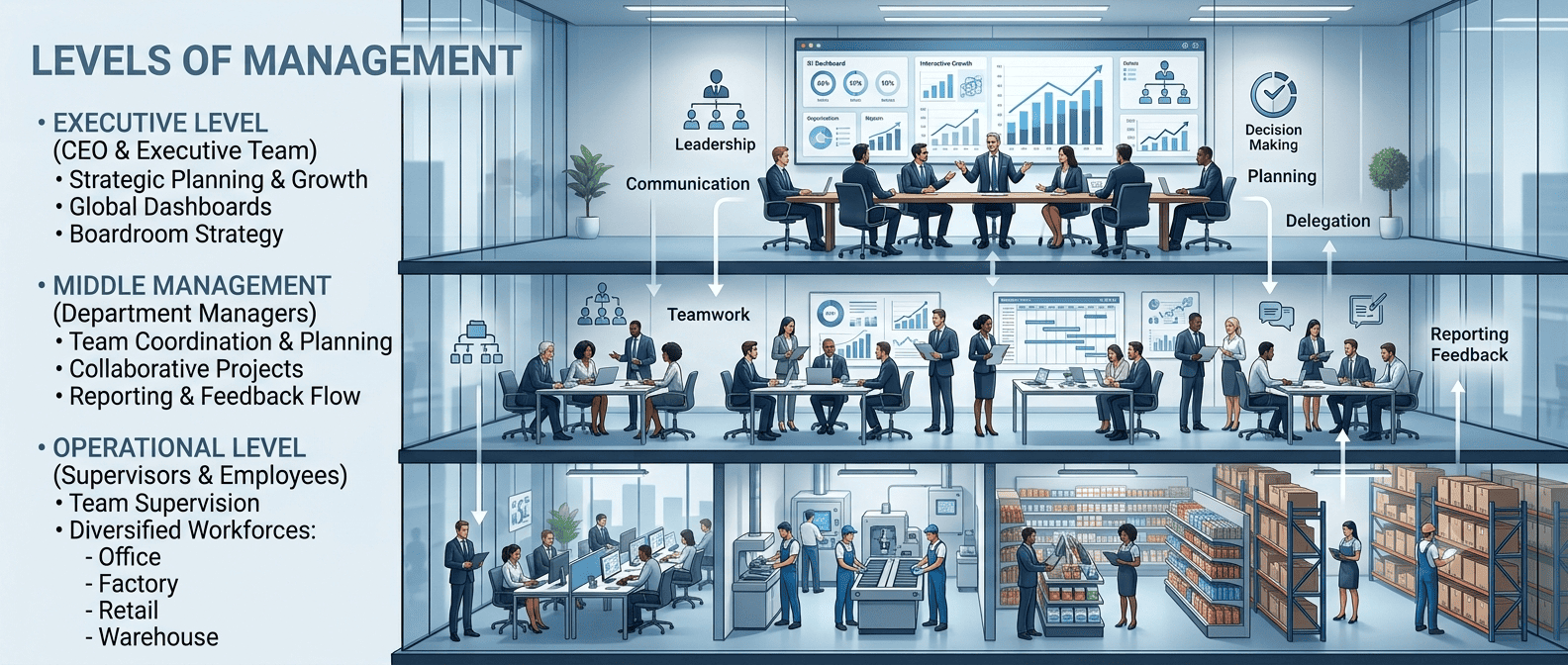
This process applies to every level of a business. A senior executive deciding whether to expand into a new market. A department head choosing between two suppliers. A team leader figuring out how to handle a staff schedule. All of these are management decisions.
Good decisions are not just about choosing the right answer. They are about following a clear, thoughtful process that leads to better outcomes consistently.
Why Decision Making Matters in Business
Every action in an organization starts with a decision. When managers decide well, teams work with direction, resources are used efficiently, and problems get solved before they grow.
The benefits go beyond just fixing issues. Strong decision making builds trust within a team. Employees follow leaders who are clear, fair, and thoughtful. It also reduces waste, because well-chosen options tend to work better on the first try.
Looking ahead, decision making will only become more important. As businesses face faster market changes, more data, and greater competition, the ability to make smart choices quickly will be a key advantage.
The Decision Making Process
A structured process turns complex choices into manageable steps. Here is the seven-step approach used by effective managers around the world.
Step 1: Identify the Problem
Start by understanding exactly what needs to be resolved. Look beyond the surface. Ask: what is actually causing this issue? A clear problem definition leads to better solutions.
Step 2: Gather Relevant Information
Collect data from internal sources, like team feedback or sales reports, as well as external sources, like market trends. Separate facts from assumptions at this stage. Decisions built on false information tend to fail.
Step 3: Generate Possible Alternatives
List several potential solutions rather than jumping to the first idea. Encourage creative thinking. Involving team members at this stage often brings in ideas that one person would not consider alone.
Step 4: Evaluate Each Alternative
Compare each option based on cost, benefit, risk, and how well it fits the organization's goals. Tools like a simple pros and cons list or a SWOT analysis (which looks at Strengths, Weaknesses, Opportunities, and Threats) can help organize this step.
Step 5: Choose the Best Option
Select the option that offers the most benefit with the least risk. This may involve trade-offs. Choosing the most practical option, rather than the ideal one, is often the smarter move.
Step 6: Implement the Decision
Put the plan into action. Assign tasks, set timelines, and make sure everyone involved knows their role. Clear communication at this stage prevents confusion later.
Step 7: Review the Results
After implementation, check whether the decision worked. Gather feedback. Compare outcomes against the original goal. This step improves future decisions by turning experience into learning.
Types of Decision Making in Management
Not all decisions work the same way. The type of decision depends on who is making it, how often it occurs, and how much impact it has.
Strategic Decisions
These are long-term decisions made by top management. They shape the direction of the entire organization. Examples include entering a new market, launching a new product line, or changing the overall business model. Strategic decisions carry high risk and require thorough research.
Tactical Decisions
Mid-level managers make tactical decisions to turn strategy into action. They are shorter in scope and more specific. If a strategic decision is to grow sales in a new city, a tactical decision might involve choosing which marketing channels to use in that city.
Operational Decisions
These are the everyday decisions that keep operations running smoothly. Scheduling staff shifts, restocking supplies, and responding to customer complaints are all operational decisions. They are usually low-risk and handled quickly by supervisors or frontline managers.
Factors That Influence Managerial Decisions
Several factors shape how managers make decisions. Understanding these helps explain why the same situation can lead to different outcomes in different organizations.
Information availability: Decisions improve when managers have accurate, complete data. Limited information increases the risk of poor choices.
Time pressure: Tight deadlines force faster decisions, sometimes with less analysis than the situation deserves.
Risk tolerance: Some managers prefer bold moves. Others prefer caution. Personal risk tolerance influences which option gets chosen.
Organizational culture: A workplace that encourages open discussion tends to produce better group decisions than one where people hold back.
Available resources: Budget, staff capacity, and technology all limit or expand what options are possible.
Legal and ethical standards: Any decision must stay within legal boundaries and align with the organization's values.
Real-World Example: A Retail Business in Lahore
Consider a mid-sized clothing retailer in Lahore facing a common challenge: slow sales during off-season months. Rather than guessing at a solution, the store manager followed a structured decision-making process.
First, she identified the real problem. Sales were not just slow overall. They were weak specifically in women's formal wear. She gathered data from her point-of-sale records and spoke to sales staff about customer feedback.
After reviewing the information, she generated three alternatives: run a discount promotion, introduce a new casual wear line for the off-season, or partner with a local fashion influencer for targeted promotion.
She evaluated each option by cost and expected reach, then chose the influencer partnership as the most cost-effective option for reaching her target audience quickly. After two months, foot traffic increased noticeably, and the store carried the approach into the following off-season.
The result came from following a process, not from guessing.
Common Mistakes Managers Make
Even experienced managers fall into patterns that weaken their decisions. According to Harvard Business School Professor Len Schlesinger, there are five pitfalls worth knowing.
Defaulting to consensus: Seeking agreement from everyone often produces average ideas rather than strong ones. Consensus is not always the best path.
Not exploring alternatives: Moving too quickly toward one solution means missing options that could work better.
Treating opinions as facts: Groups can mistake strong opinions for reliable data. Someone should always be responsible for checking whether information is actually verified.
Losing sight of the goal: Long discussions can pull a team away from the original purpose. Revisiting the stated objective regularly keeps decisions on track.
Shutting down debate too early: The best decisions come from environments where people feel safe speaking up. Cutting debate short loses valuable input.
Practical Application
Knowing the theory is one thing. Applying it daily is another. Here are practical steps managers can take right away.
Before any significant decision, write down the problem clearly in one or two sentences.
Set a rule: always generate at least three alternatives before settling on one.
Assign someone in group discussions to fact-check claims as they come up.
After implementing a decision, schedule a short review two to four weeks later to assess results.
These small habits, practiced consistently, build better judgment over time.
Key Takeaways
Decision making in management is a structured process, not a guessing game.
There are three main types of decisions: strategic, tactical, and operational.
The seven-step process provides a reliable framework for any significant choice.
Factors like time pressure, risk tolerance, and available information all shape outcomes.
Common mistakes include rushing, ignoring alternatives, and stopping debate too early.
Reviewing decisions after implementation is just as important as making them.
Better Decisions Build Better Businesses
Decision making is not just a management skill. It is the foundation of how any organization moves forward. From a small café owner in Karachi to a retail manager in Lahore, the principles are the same: understand the problem, gather the facts, explore your options, and review what happens after.
The managers who build strong decision-making habits are the ones who lead with confidence, adapt quickly to change, and build teams that trust them. Start with the seven-step process. Avoid the common pitfalls. And remember that every decision, big or small, is an opportunity to improve.