TL;DR: Management is the process of planning, organizing, leading, and controlling resources to achieve organizational goals. Effective management directly determines whether a business succeeds or fails, regardless of its size, industry, or location. Every manager needs a blend of technical, human, conceptual, and decision-making skills to guide their team toward consistent results.
A clothing store on Lahore's busy MM Alam Road was pulling in strong foot traffic. The owner had a great product, a central location, and a loyal customer base built over years. But behind the scenes, things were unraveling. Staff showed up late without consequence. Inventory was ordered based on gut feeling, not data. Responsibilities overlapped or were forgotten entirely. Within two years, the store went from profitable to barely breaking even.
The product had not changed. The location had not changed. What was missing was a grasp of management principles.
This post breaks down what management really means, why it matters, and how to apply its core principles, whether you are running a five-person team or a five-hundred-person company.
What Is Management?
Management is the process of coordinating people, resources, and activities to achieve defined goals efficiently and effectively. It is not just about giving orders. Management involves making decisions, setting direction, supporting people, and tracking outcomes.
Peter Drucker, widely regarded as the father of modern management, described the manager's job as making work productive and the worker achieving. That framing still holds. Good management creates conditions where both the organization and the people within it can grow.
Why Does Management Matter?
Poor management is one of the leading reasons businesses fail. A 2019 Gallup study found that managers account for at least 70% of the variance in employee engagement scores. Low engagement correlates directly with higher turnover, lower productivity, and weaker customer satisfaction.
Strong management does the opposite. It aligns effort with strategy, prevents costly mistakes, and creates an environment where people want to contribute. For startups and small businesses especially, the quality of management often matters more than the quality of the product.
The Four Core Functions of Management
Planning: Deciding What Should Be Done
Planning means defining goals and determining the best path to reach them. This includes setting short-term targets, anticipating obstacles, and allocating resources before work begins. Without a plan, teams default to reacting, and reactive businesses rarely grow with intention.
Organizing: Arranging Resources Efficiently
Once a plan exists, resources need to be arranged to execute it. Organizing involves assigning roles, establishing reporting structures, and ensuring the right people have what they need to do their jobs. A well-organized team minimizes duplication and confusion.
Leading: Motivating People to Perform
Leadership is the human side of management. Leading means communicating vision, building trust, resolving conflict, and keeping people motivated, especially when conditions change. The best managers do not just delegate tasks; they develop people.
Controlling: Measuring Performance
Controlling is about tracking progress against goals and correcting course when needed. This includes performance reviews, financial reporting, quality checks, and operational audits. Without this function, small problems quietly become large ones.
Management Skills Every Manager Needs
Technical Skills
These are the job-specific competencies needed to perform or oversee work. A production manager needs to understand the manufacturing process. A finance manager needs to read a balance sheet. Technical skills are most critical at entry and mid-level management.
Human Skills
Human skills, sometimes called interpersonal or soft skills, are the ability to work with, motivate, and communicate effectively with people. These skills matter at every level of management, but become increasingly critical as a manager's span of responsibility grows.
Conceptual Skills
Conceptual skills involve the ability to think strategically, see the big picture, and understand how different parts of an organization connect. Senior managers rely heavily on conceptual thinking to navigate complexity and make long-term decisions.
Decision-Making Skills
Every management function requires decisions. Strong managers gather relevant information, weigh options, account for risk, and commit to a course of action without unnecessary delay. Indecision is itself a decision, and usually a costly one.
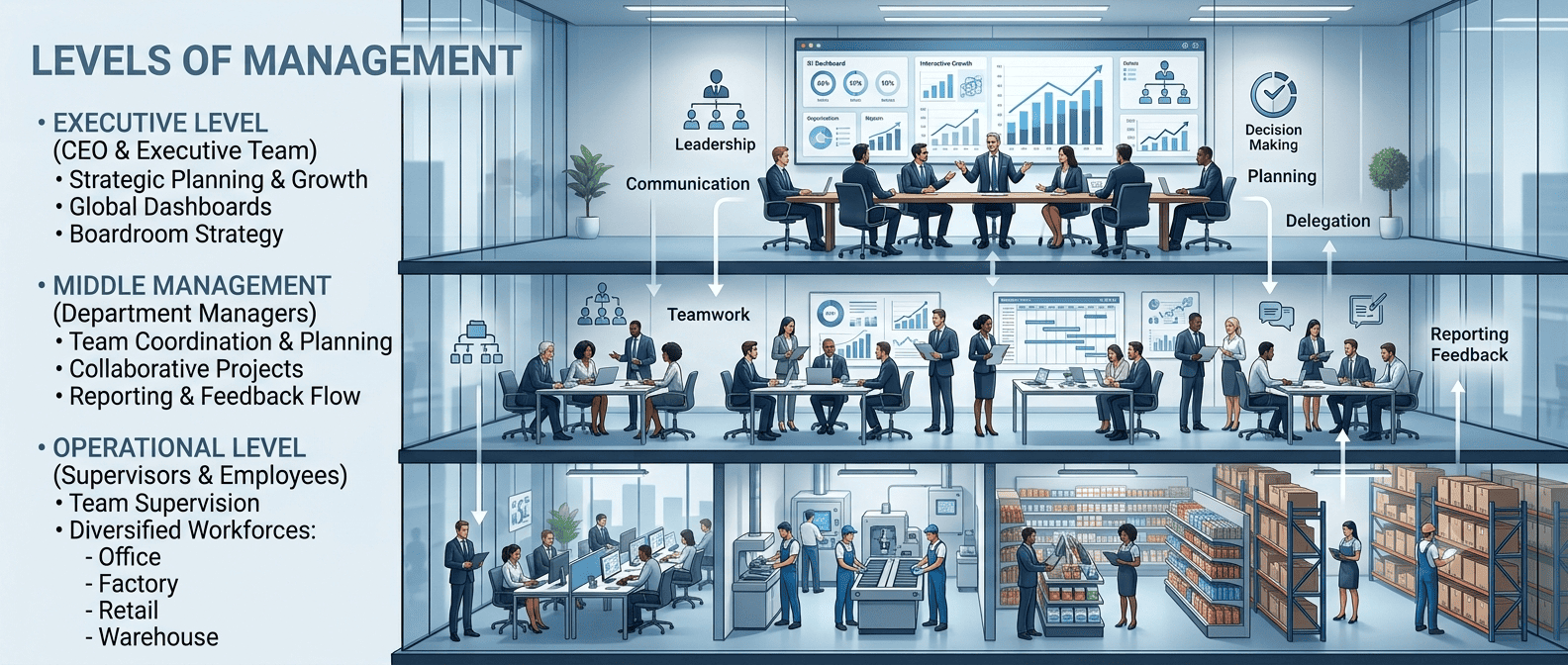
Different Levels of Management
Most organizations have three tiers:
Top-level management (CEOs, directors, owners): Sets organizational strategy and long-term direction.
Middle-level management (department heads, regional managers): Translates strategy into departmental plans and oversees execution.
Front-line management (supervisors, team leaders): Directly manages day-to-day operations and individual staff.
Each level requires a different balance of skills. Top managers lean heavily on conceptual thinking. Front-line managers rely more on technical and human skills.
Characteristics of Effective Management
Effective management is consistent, transparent, and goal-oriented. Effective managers communicate expectations clearly, hold themselves and others accountable, and adapt their style to the needs of the situation. They make decisions with available information rather than waiting for certainty, and they treat feedback, both upward and downward, as a tool for improvement, not a threat.
A Realistic Case Study: Chai Corner, Islamabad
Chai Corner was a family-owned café in Islamabad's F-7 sector. By 2021, the second-generation owner, Bilal, had taken over from his father. The café had loyal regulars, but staff turnover was high, daily operations felt chaotic, and monthly costs kept creeping up without any clear reason.
Bilal enrolled in a short business management course and came back with a plan. He introduced weekly team check-ins, defined clear roles for each staff member, and started tracking daily sales and ingredient costs in a simple spreadsheet.
Within six months, turnover dropped by 40%. Food waste decreased because orders were now based on weekly sales trends rather than estimates. Staff morale improved because people understood their responsibilities and received regular feedback. By the end of the year, Chai Corner had opened a second location.
Nothing about the café's recipe or concept changed. What changed was how it was managed.
Common Management Mistakes
Even experienced managers fall into predictable traps:
Micromanaging: Taking over tasks instead of developing the people responsible for them.
Avoiding difficult conversations: Letting performance issues fester until they become team-wide problems.
Ignoring data: Making decisions based on instinct when better information is available.
Failing to delegate: Treating every decision as equally important, which creates bottlenecks.
Neglecting communication: Assuming that because a goal is clear to the manager, it is clear to the team.
Recognizing these patterns is the first step toward correcting them.
Practical Application
Start small. Managers at any level can improve by:
Writing down clear goals for their team each quarter
Scheduling regular one-on-one check-ins with direct reports
Reviewing one key performance metric weekly and sharing it with the team
Asking for feedback after major projects and acting on what they hear
These habits will not transform an organization overnight, but they compound. Over time, consistent management practice builds the kind of culture where people perform well because they are supported, not because they are watched.
Key Takeaways
Management is the process of planning, organizing, leading, and controlling resources toward defined goals.
The four core management functions, planning, organizing, leading, and controlling, work together. Weakness in any one area affects the others.
Effective managers develop technical, human, conceptual, and decision-making skills throughout their careers.
Management quality directly impacts employee engagement, operational efficiency, and business outcomes.
Small, consistent practices, not sweeping changes, tend to produce lasting management improvements.
Good Management Principles Do Not Happen by Accident
The Lahore clothing store did not fail because the market dried up. Chai Corner did not succeed because Bilal got lucky. In both cases, management, its absence or presence, was the deciding factor.
Understanding management is the starting point. Applying it consistently is what separates organizations that survive from those that grow. Whether you are leading a team of two or two hundred, the principles are the same: set clear goals, organize your resources, support your people, and measure what matters.
Start with one function. Improve it. Then build from there.