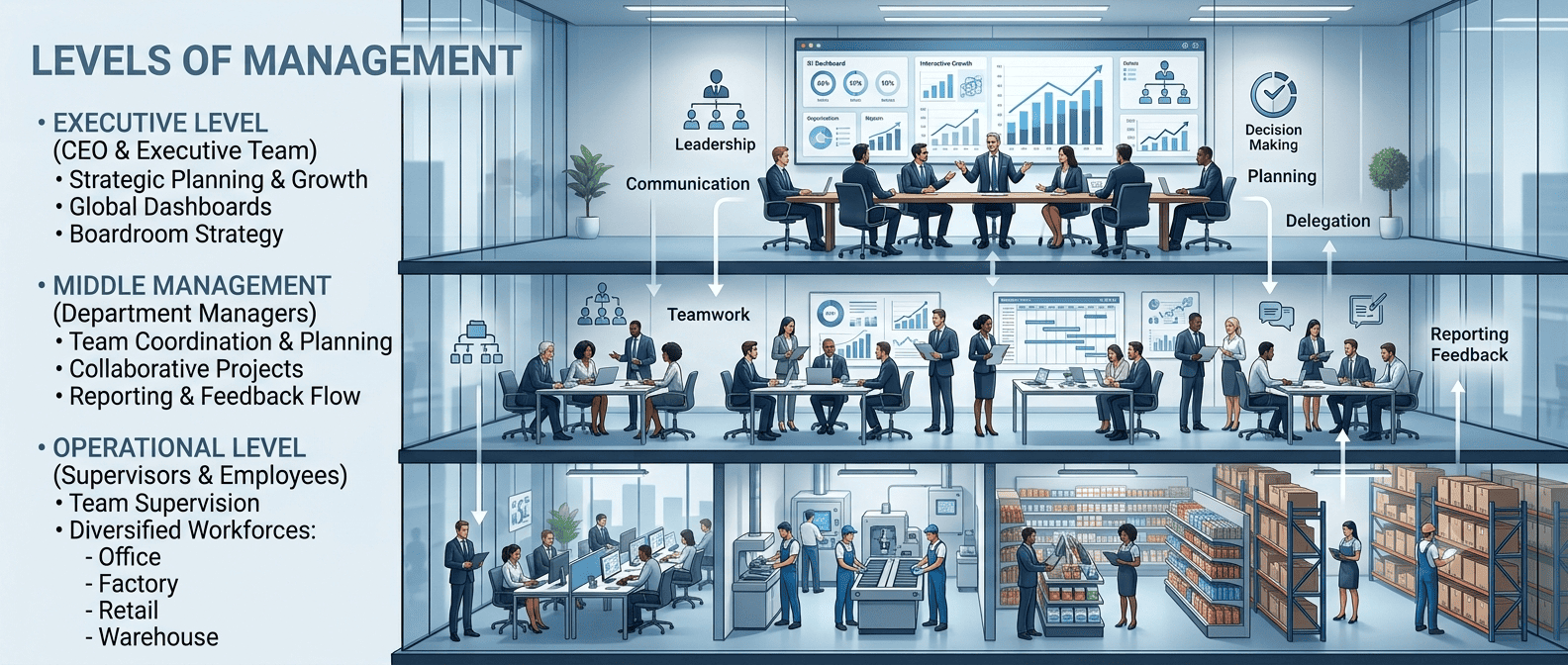
Good management does not happen by accident. Behind every successful business, there is a manager who knows how to plan ahead, organise their team, guide people effectively, and keep everything on track. These four activities are known as the functions of management, and they form the foundation of how businesses operate at every level.
This post breaks down each function in plain, simple language. You will learn what each one means, why it matters, and how it plays out in real workplaces. By the end, you will have a clear understanding of the functions of management and how to apply them, whether you are studying business or thinking about running one yourself.
What Are the Functions of Management?
The four functions of management are planning, organising, leading, and controlling. They were first introduced by Henri Fayol, a French management theorist, in the early 20th century. Together, they form a framework, often called the POLC model, that helps managers handle nearly any business challenge in a structured way.
These functions are not separate steps that happen once. They are ongoing, overlapping activities that managers return to again and again.
Why Do the Functions of Management Matter?
Without these functions, teams lose direction. Resources get wasted. Employees become confused about their roles. Businesses fall short of their goals.
The functions of management give structure to decision-making. They help managers think clearly, act purposefully, and measure results. A manager who understands and applies all four functions is far better equipped to lead their team to success, regardless of the size or type of business they run.
The Four Functions of Management
Planning: Deciding What Needs to Be Done
What it means: Planning is the process of setting goals and figuring out how to achieve them. A manager looks at where the business is now, where it wants to go, and what steps are needed to get there. This includes allocating resources, setting timelines, and anticipating problems before they happen.
Why it matters: Planning gives everyone a shared direction. Without it, a team can work very hard and still move nowhere useful. A clear plan also makes it easier to spot when something is going wrong.
Workplace example: A software startup in Karachi is preparing to launch a new mobile app. The product manager creates a timeline covering development, testing, and marketing. Each team member knows their deadlines and responsibilities before the project begins.
Common challenge: Many managers skip proper planning when they feel pressure to act quickly. Rushing into execution without a clear plan often leads to costly mistakes and rework later on.
Organising: Arranging Resources Efficiently
What it means: Once a plan exists, organising is about putting the right people, tools, and resources in place to carry it out. This includes assigning tasks, defining roles, establishing communication channels, and structuring the team so that everyone knows what they are responsible for.
Why it matters: A solid plan falls apart without proper organisation. When roles are unclear or resources are misallocated, work gets duplicated, important tasks get missed, and teams become frustrated.
Workplace example: A clothing store in Lahore is preparing for a major seasonal sale. The store manager assigns one team member to handle stock replenishment, another to manage the fitting rooms, and a third to handle customer payments. Each person has a clear role, so the store runs smoothly even during peak hours.
Common challenge: New managers often try to handle too many tasks themselves instead of distributing work across the team. This leads to burnout and bottlenecks.
Leading: Motivating and Guiding Employees
What it means: Leading is about influencing and inspiring people to work toward the organisation's goals. It involves communicating clearly, building trust, resolving conflicts, and adjusting your approach based on the needs of individual team members. Leadership is not limited to those in formal management roles; it can come from anyone in a team.
Why it matters: Even the best plan, backed by excellent organisation, will fail if people are not motivated or engaged. Good leadership creates a positive environment where people feel valued and are willing to give their best.
Workplace example: A café owner in Islamabad notices that her team seems tired and low on energy during a busy weekend rush. She steps in to help with orders, thanks her staff publicly for their hard work, and adjusts break times to give everyone a rest. The mood lifts, and service quality improves immediately.
Common challenge: New managers often confuse leading with micromanaging. Checking in on progress is healthy; watching every small action your team takes is not. Micromanagement damages trust and reduces productivity.
Controlling: Measuring Performance and Making Improvements
What it means: Controlling involves monitoring progress, comparing actual results to the original plan, and making adjustments when needed. It is not about restricting employees; it is about making sure the team stays on course and that any issues are identified and resolved quickly.
Why it matters: Without controlling, a business has no way to know if its goals are being met. Regular monitoring allows managers to catch problems early, celebrate wins, and continuously improve how the organisation works.
Workplace example: A bakery owner in Rawalpindi reviews daily sales reports at the end of each week. She notices that croissant sales have dropped significantly while cinnamon rolls are selling out by midday. She adjusts her production schedule accordingly, making more cinnamon rolls and reducing croissant output to reduce waste.
Common challenge: Many beginners only review performance at the end of a project, rather than throughout. By that point, it is often too late to make meaningful corrections. Controlling should be a continuous process, not a final step.
How the Four Functions Work Together
The four functions of management are most powerful when they work as a connected system. Planning sets the goal. Organising puts the right resources in place. Leading keeps the team motivated and focused. Controlling checks that the goal is being reached and adjusts the plan if necessary.
Skipping any one of these functions weakens the entire process. A manager who plans and organises well but fails to lead will lose team engagement. A manager who leads brilliantly but never controls outcomes has no way of knowing if the business is actually improving.
Real-World Case Study: Ali's Bakery in Islamabad
Ali runs a small bakery in Islamabad. With Eid approaching, he wants to boost sales by introducing a range of special holiday products. Here is how all four functions of management come into play.
Planning: Ali decides three weeks in advance which new items to offer, how many units to produce each day, and how to price them to stay competitive while covering costs.
Organising: He assigns his senior baker to handle the new recipes, designates a counter staff member to manage customer orders, and arranges for a delivery person to handle online orders placed through WhatsApp.
Leading: Mid-week, Ali notices his team is feeling the pressure of the extra workload. He holds a short team meeting, acknowledges their effort, and clarifies priorities to reduce confusion. The team feels supported and refocuses.
Controlling: At the end of each day, Ali checks how many units were sold versus how many were produced. He notices that one product is barely selling, so he reduces its production and shifts those ingredients toward the more popular items.
By applying all four functions, Ali runs a smooth and profitable Eid operation, without unnecessary waste or confusion.
Common Mistakes Beginners Make
Understanding the functions of management is one thing. Applying them consistently is another. Here are some mistakes to watch out for:
Skipping the planning phase and jumping straight into action, which often leads to wasted time and resources
Treating the four functions as separate steps rather than a continuous, integrated cycle
Confusing leading with micromanaging, which damages morale and reduces team confidence
Only reviewing performance at the end of a project instead of monitoring progress throughout
Management Self-Assessment
Use these reflective questions to evaluate how well you are applying the four functions of management in your own role or studies:
Planning: Do I set clear goals before starting a project? Do I identify potential obstacles in advance?
Organising: Are tasks distributed fairly across the team? Does everyone know their responsibilities?
Leading: Do I communicate expectations clearly? How do I respond when team members are struggling?
Controlling: Do I regularly check progress against goals? When something is off track, how quickly do I address it?
If you find gaps in any of these areas, that is a useful starting point for development.
Key Takeaways
The four functions of management are planning, organising, leading, and controlling
Henri Fayol introduced these functions in the early 20th century
Each function plays a distinct and essential role in achieving business goals
All four functions work best when applied together as a connected system
Regular self-assessment helps managers identify and close gaps in their practice
Start Applying These Principles Today
Understanding the functions of management gives you a practical framework for navigating real business challenges. These are not abstract theories reserved for MBA classrooms. They are everyday tools that help managers at all levels make better decisions, build stronger teams, and achieve their goals.
Start small. Pick one of the four functions and reflect on how well you currently apply it. From there, look for simple ways to strengthen your approach. Over time, consistent practice across all four functions will make a meaningful difference in how you lead and how your team performs.