Not every customer wants the same thing. A teenager buying sneakers has completely different priorities than a 45-year-old buying dress shoes for work. Market segmentation is the tool that helps businesses recognize these differences—and act on them.
This guide breaks down everything you need to know about market segmentation: what it is, why it matters, the four main types, real-life examples, and practical tips to help you get started. Whether you are a marketing student or a beginner trying to understand how businesses reach the right people, this post is for you.
What is Market Segmentation?
Market segmentation is the process of dividing a large market into smaller groups of people who share similar characteristics. Instead of trying to sell to everyone at once, businesses focus their efforts on specific groups, called segments, that are most likely to respond to their product or message.
Think of it like sorting a bag of mixed candies. Instead of handing out random pieces, you organize them by flavor so each person gets exactly what they like. Market segmentation works the same way.
Why Market Segmentation Matters
When a business tries to market to everyone, it often ends up connecting with no one. Messages become too broad. Resources get wasted on people who were never likely to buy. Products miss the mark because they were not designed with a specific customer in mind.
Market segmentation helps businesses speak directly to the right people, in the right way, at the right time. According to Qualtrics, companies that use market segmentation effectively benefit from stronger marketing messages, better response rates, lower customer acquisition costs, and improved brand loyalty. They are also better positioned to identify niche markets and develop products that customers actually want.
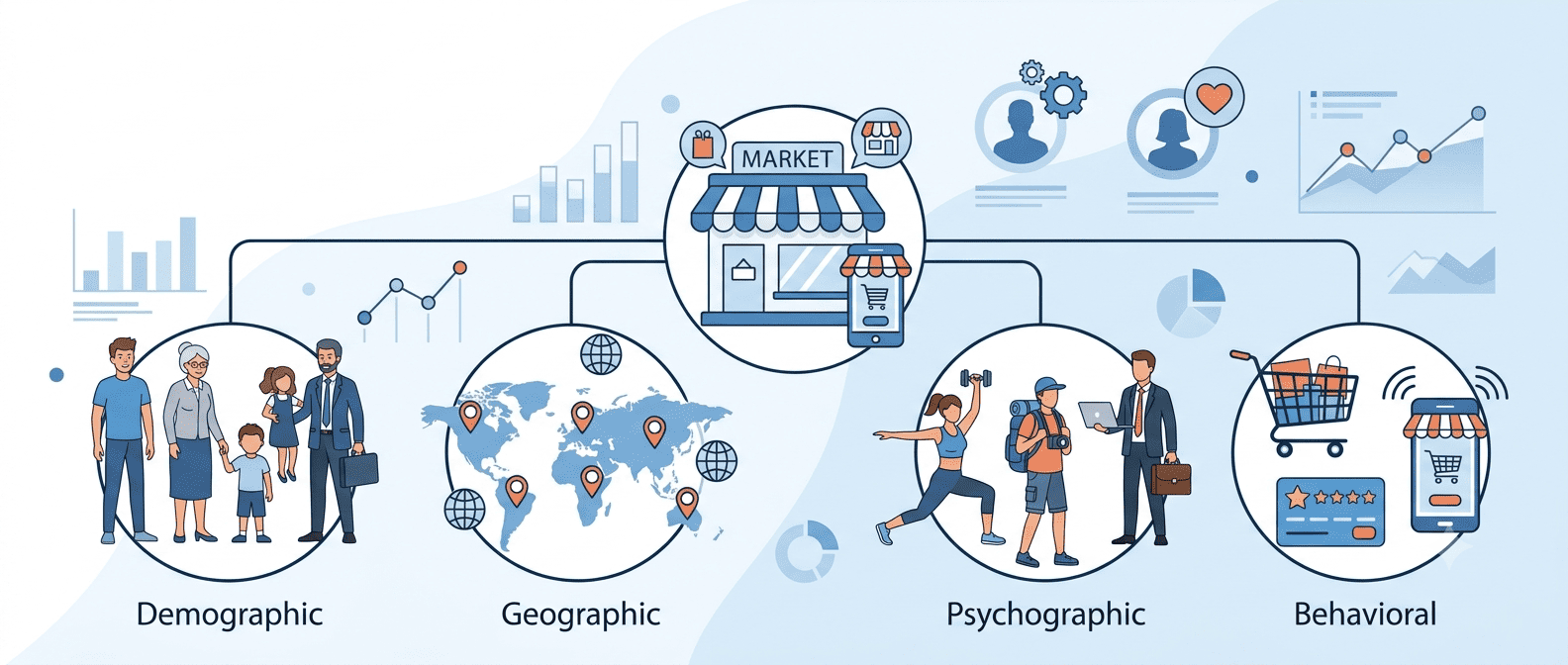
The 4 Main Types of Market Segmentation
1. Demographic Segmentation
Demographic segmentation divides people by personal attributes such as age, gender, income, education, occupation, and family size. It is the most common type of segmentation because these factors strongly influence what people buy and how much they are willing to spend.
Example: A luxury car brand targets high-income adults aged 35 to 60, while a budget car brand focuses on younger buyers with entry-level incomes.
2. Geographic Segmentation
Geographic segmentation groups customers based on where they live, whether that is a country, city, region, or climate. Customer preferences often vary by location, so knowing where your audience is helps you tailor your offering accordingly.
Example: A clothing retailer sells heavy coats in colder northern regions and lightweight linen in warmer southern states.
3. Psychographic Segmentation
Psychographic segmentation goes deeper than demographics. It focuses on lifestyle, personality, values, opinions, and interests. Two people with the same income and age can have completely different buying behaviors based on what they care about.
Example: A fitness brand targets health-conscious consumers who prioritize clean eating and regular exercise, regardless of their age or location.
4. Behavioral Segmentation
Behavioral segmentation groups customers by how they interact with a product or brand. This includes purchase history, product usage, brand loyalty, and buying frequency.
Example: A coffee brand creates a loyalty program for customers who buy three or more times per week, while running introductory offers for first-time buyers.
Real-Life Example: How a Smartphone Company Uses Market Segmentation
A smartphone company does not sell just one phone to just one type of customer. It uses multiple types of segmentation to reach different groups:
Demographic: Budget-friendly models for students and teens; premium models for working professionals.
Geographic: Phones with dual SIM cards for markets where multiple carriers are common; enhanced camera features for regions where social media usage is high.
Psychographic: Eco-friendly packaging and sustainability messaging for environmentally conscious buyers.
Behavioral: Upgrade deals targeting loyal customers who have owned the brand's phone for two or more years.
This layered approach allows the company to serve a global market while making each customer feel like the product was made specifically for them.
Comparison Table: Types of Market Segmentation
Type | Based On | Example | Best Used For |
Demographic | Age, gender, income, education | Targeting women aged 25 to 40 with mid-range incomes | Simple, first-step segmentation |
Geographic | Location, region, climate | Selling winter jackets in colder climates | Location-specific products or services |
Psychographic | Lifestyle, values, personality | Marketing organic food to health-conscious consumers | Value- or interest-driven products |
Behavioral | Purchase habits, usage, loyalty | Rewarding frequent buyers with a loyalty program | Building customer retention |
Advantages and Disadvantages of Market Segmentation
Advantages:
More targeted and effective marketing messages
Better use of budget and resources
Higher customer satisfaction and loyalty
Easier product development based on real customer needs
Disadvantages:
Time-consuming to research and implement properly
Risk of creating segments that are too narrow to be profitable
Segments can become outdated as customer behavior changes
May require ongoing research and tools to maintain accuracy
Common Mistakes in Market Segmentation
1. Making segments too small
Highly specific segments might seem precise, but if the group is too small, it will not generate enough sales to justify the effort. Make sure each segment is large enough to be profitable. Ask yourself: can this group realistically generate a meaningful return?
2. Ignoring buying power
A large segment means nothing if people in it cannot afford your product or are not motivated to buy. Always evaluate whether a segment has both the interest and the financial capacity to purchase from you.
3. Being too rigid with your segments
Markets change. Customers evolve. A segment that was relevant two years ago may look very different today. Review and refresh your segments regularly, at least once a year, or whenever major shifts occur in your market or customer behavior.
4. Using only one type of segmentation
Relying on a single segmentation method gives you an incomplete picture of your customer. Combining two or more segmentation types leads to richer, more actionable insights. For example, pair demographic data with behavioral data to understand not just who your customer is, but how they shop.
Practical Tips for Getting Started
Start simple. Pick one or two segmentation types to begin with, then layer in more as you learn.
Use real data. Surveys, customer interviews, and purchase history are more reliable than assumptions.
Test your segments. Run a small campaign for each segment before committing a large budget.
Keep refining. Segmentation is not a one-time task. It improves the more you revisit it.
Focus on actionability. A good segment should change how you market, not just how you categorize.
Key Takeaways
Market segmentation divides a market into smaller, more targeted groups.
The four main types are demographic, geographic, psychographic, and behavioral.
Effective segmentation leads to better marketing, stronger loyalty, and smarter product development.
Avoid common mistakes like making segments too narrow or failing to update them over time.
Start with simple segmentation, use real data, and refine your approach regularly.
Start Segmenting Smarter
Market segmentation is the foundation of connecting with the right people at the right time. Once you understand your audience in segments, everything else becomes easier. Your messaging sharpens, your budget goes further, and your customers feel genuinely understood.
Start small, stay curious, and keep revisiting your segments as your market evolves. The businesses that do this consistently are the ones that grow.