A target market is something every successful business has clearly defined. A new shoe brand doesn't try to sell to every person on the planet. A luxury hotel doesn't market itself to budget backpackers. They've each identified who their ideal customer is, and that focus is what makes their marketing work.
So what is a target market, and why does it matter? This guide breaks it all down in simple terms. By the end, you'll understand the four main types of target markets, see how real companies like Nike use them, and know the common mistakes businesses make when trying to reach customers.
Why Does a Target Market Matter?
A target market is the specific group of people a business wants to reach with its products or services. According to Investopedia, a target market is defined as "the specific segment of the consumer population that a company aims to attract and serve with its marketing efforts and product strategies." Put simply, it's your ideal customer, the person most likely to buy what you're selling.
Knowing your target market shapes nearly every business decision. It influences how a product is designed, priced, packaged, and advertised. A company that tries to appeal to everyone usually ends up appealing to no one. Focus is what drives results.
Types of Target Markets
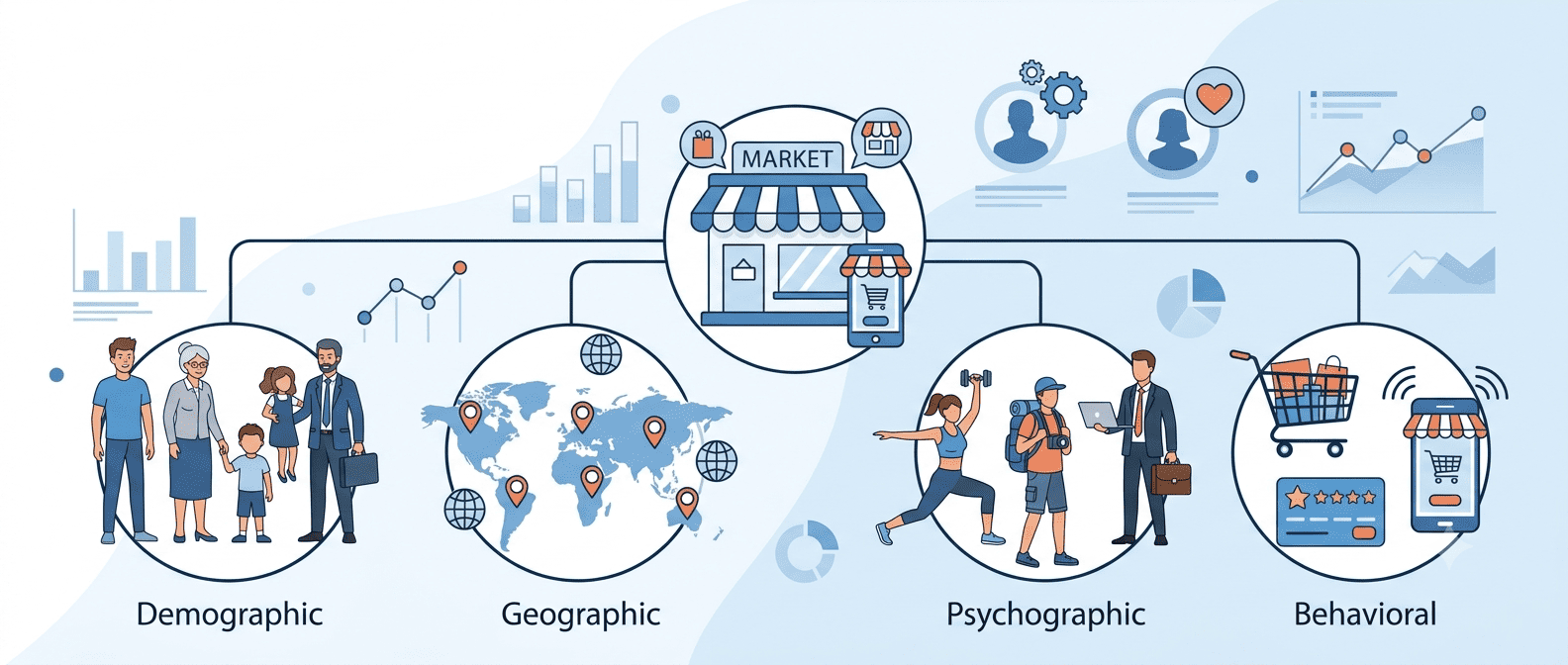
Marketers typically divide customers into four main segments. Each one looks at the audience from a different angle.
Demographic Segmentation (Age, Income, Gender)
Demographics are the most basic way to describe a group of people. This includes age, gender, income level, education, and occupation. For example, a toy company might target children aged 4–10, while a luxury car brand targets adults with a high income. Demographics give businesses a clear starting point for understanding who their customer is.
Geographic Segmentation (Location)
Where people live affects what they buy. Geographic segmentation groups customers by country, region, city, or even climate. A company selling winter coats focuses on colder regions. A sunscreen brand targets areas with high sun exposure. Location also affects language, culture, and local preferences — all of which matter in marketing.
Psychographic Segmentation (Lifestyle and Values)
Psychographics go deeper than basic demographics. This type of segmentation looks at a person's lifestyle, values, interests, and personality. Two people of the same age and income might have very different shopping habits. One might prioritize eco-friendly products; the other might focus on performance and quality. Psychographic segmentation helps businesses connect with customers on a deeper, more personal level.
Behavioral Segmentation: Understanding Your Target Market Through Buying Habits
Behavioral segmentation focuses on how customers act. It looks at how often people buy a product, how loyal they are to a brand, and what benefits they're looking for. This type of segmentation is especially powerful because it's based on real customer data, not just assumptions.
What Is Behavioral Segmentation?
Behavioral segmentation can be broken into several key areas:
Purchase frequency: How often does a customer buy? A daily coffee drinker is a different customer than someone who treats themselves once a month.
Brand loyalty: Some customers always return to the same brand. Others switch based on price or availability.
Product usage: Heavy users, moderate users, and infrequent users each have different needs.
Benefits sought: What does the customer want most? Speed? Savings? Quality?
Buying occasions: People buy for different reasons, including birthdays, seasonal sales, or everyday needs.
A great real-world example is the coffee shop loyalty rewards program. Many coffee shops offer a rewards card or app that tracks purchases. Customers earn points every time they buy a drink. This targets loyal, frequent buyers with incentives to keep coming back. It's behavioral segmentation in action, where the business identifies its best customers and rewards them to increase retention.
Real-Life Example: How Nike Uses a Target Market
Nike is one of the best examples of smart target market strategy. Founded in 1964, Nike's mission is to "bring inspiration and innovation to every athlete worldwide." But Nike doesn't stop at professional athletes.
Nike uses all four types of segmentation to reach its customers:
Demographic: Nike primarily targets people aged 15 to 45, covering teens, young adults, and middle-aged consumers. According to Piper Sandler's 2024 research, Nike was the #1 footwear brand among US teens that year.
Geographic: Nike operates in over 190 countries and tailors its products by region, offering lightweight, breathable shoes for hot climates and insulated gear for colder areas.
Psychographic: Nike doesn't just sell shoes. It sells an attitude. The iconic "Just Do It" campaign, launched in the late 1980s, targeted people who value achievement, performance, and pushing their limits.
Behavioral: Nike's loyalty program, Nike+, rewards frequent buyers with exclusive deals, personalized content, and early access to new products, keeping their most engaged customers coming back.
By using all four segmentation types together, Nike reaches a wide but well-defined audience across the globe.
Comparison Table: The Four Types of Market Segmentation
Type | What It Looks At | Key Variables | Example |
Demographic | Who the customer is | Age, gender, income, education | Targeting adults aged 25–40 with mid-to-high income |
Geographic | Where the customer is | Country, region, city, climate | Selling waterproof jackets in rainy regions |
Psychographic | What the customer values | Lifestyle, interests, personality | Targeting eco-conscious consumers |
Behavioral | How the customer acts | Purchase habits, loyalty, usage | Rewarding frequent coffee shop visitors |
Advantages of Knowing Your Target Market
Better Marketing Efficiency
When you know who you're talking to, you stop wasting money on people who were never going to buy. Marketing messages become more relevant, and ad spend is directed where it actually works.
Stronger Customer Relationships
Customers feel understood when a brand speaks directly to their needs. A coffee shop that rewards loyal customers builds stronger relationships than one that treats every visitor the same way.
Better Business Decisions
From product design to pricing, knowing your target market improves decision-making across the board. Companies can develop products that genuinely solve their customers' problems.
Competitive Advantage
A business that knows its target market well can spot gaps in the market that competitors miss. That focus leads to differentiation, and differentiation drives growth.
Disadvantages
Research Takes Time
Identifying a target market requires surveys, data analysis, interviews, and testing. For small businesses or students running class projects, this investment of time can feel overwhelming.
Customer Preferences Change
People don't stay the same. Trends shift, economies change, and new generations develop different values. A target market that works today may need to be updated in a few years.
Risk of Choosing the Wrong Market
If a business misreads its audience, the consequences can be significant. Products may go unsold, and marketing budgets may be wasted on the wrong people.
Common Mistakes
Trying to Sell to Everyone
This is the most common mistake. "Everyone" is not a target market. The broader the audience, the harder it is to write a clear message, design the right product, or choose the right advertising channel.
Ignoring Customer Research
Assumptions are dangerous. Many businesses make decisions based on what they think their customers want, rather than what research actually shows. Surveys, interviews, and sales data should drive target market decisions, not guesswork.
Never Updating the Target Market
Markets evolve. A brand that defined its target market in 2010 and hasn't revisited it since is likely missing a large portion of potential customers. Regular reviews keep the strategy relevant.
Confusing Target Market with Market Segmentation
These two terms are related but different. Market segmentation is the process of dividing a large market into smaller groups. A target market is the specific segment a business chooses to focus on. Segmentation is the method; target market is the decision.
Practical Tips for Identifying a Target Market
Start with your product: What problem does it solve? Who has that problem?
Analyze your existing customers: If you already have buyers, look at who they are. Age, location, and buying patterns are a great starting point.
Research competitors: Who do your competitors target? Are there groups they're ignoring that you could serve?
Create a customer persona: Write a short profile of your ideal customer — give them a name, a job, a problem, and a goal. This makes the abstract feel real.
Test and refine: Your first target market doesn't have to be perfect. Run small campaigns, see what works, and adjust.
Target Market vs Target Audience
Target Market | Target Audience |
The overall group a business wants to serve | A specific group for one marketing campaign |
Long-term business strategy | Campaign-specific |
Example: Teen athletes | Example: Instagram users aged 16-22 |
Key Takeaways
A target market is the specific group of customers a business wants to reach.
The four types of market segmentation are demographic, geographic, psychographic, and behavioral.
Behavioral segmentation focuses on how customers act, including their loyalty, purchase frequency, and the benefits they seek.
Real brands like Nike use all four types of segmentation to connect with a wide but well-defined global audience.
Knowing your target market improves marketing efficiency, strengthens customer relationships, and sharpens business decisions.
Common mistakes include trying to appeal to everyone, skipping customer research, and failing to update the target market over time.
Understanding Your Target Market Is the First Step to Marketing Success
A well-defined target market isn't just a marketing concept. It's the foundation of a smart business strategy. The companies that take the time to truly understand their customers are the ones that build lasting brands, run more efficient campaigns, and grow faster than those that don't.
Start small. Define who your ideal customer is. Research what they want. Then speak directly to them, because a message designed for everyone often resonates with no one.
Meta Data
Meta title
Meta description